








Patients, clinicians, and partners form impressions of a healthcare provider long before they interact with it. A clear brand helps them understand the offer and why they can rely on the company, establishing credibility along the way.


People tend to choose a clinic or health app by the signals they can read, like a clear service page or real credentials in doctor profiles. The need for clarity is particularly pressing following a significant decline in public trust in healthcare.
In a 50-state survey of more than 443,000 U.S. adults, the share of people with a lot of trust in physicians and hospitals fell from 71.5% in April 2020 to 40.1% in January 2024. Healthcare branding cannot replace clinical quality, but it can still help providers communicate their expertise, set clear expectations, and give patients more reasons to feel confident in their choice.
Healthcare branding is how a provider’s brand strategy takes shape through positioning, visual identity, tone of voice, and guidelines.

The role of positioning is to define the place a provider holds in patients’ minds. The brand promise tells patients what they’ll get. In healthcare, a good one is specific and provable, for example, “same-week appointments with a pediatric specialist.” Patients can check whether this service is available, unlike vague claims such as “excellent care.”
Another element of a healthcare brand identity is visual identity. It involves a logo, color palette, typography, icons, and photography style. When patients see these things, they form first impressions. For instance, a white-and-blue palette may feel professional but impersonal, while overly playful graphics can seem out of place in a serious medical setting.
The logo type matters too. A wordmark suits a provider whose name is its main asset; a symbol works better on a small app icon. Since healthcare products serve people with different visual abilities, contrast and font size belong in the brief from day one.
Tone of voice and messaging define how a healthcare provider communicates with patients across media. The language should convey expertise while remaining clear, warm, and easy to understand. A few practical principles help strike that balance:
Healthcare branding guidelines help maintain consistency as more people work with the brand. With documented logo use, colors, typography, voice, and imagery, a new page will follow the same standards as the old ones. For digital products, a design system turns these standards into reusable interface components, so teams don’t have to design every element from scratch.
A healthcare brand needs to connect with several groups, each with different expectations. Patients look for safety and understanding, partners for reliability, and clinicians for professional standards that also influence clinical trust in digital tools. This section focuses on understanding all of them.

Patients often search for a healthcare provider when they’re worried about their health or unsure what to do next. Before booking an appointment, patients want to see that the provider treats their condition, learn about the doctors’ qualifications and experience, and find out how soon they can be seen and what their insurance covers. They also look for signs that they’ll be treated with respect, from the language on the website to the photos and patient reviews. Families have an additional concern: will the care team keep them informed and involve them in decisions about their loved one’s care?
For clinicians, the organization’s reputation is closely tied to their own. Their main concern is whether its public messages reflect the care they actually provide. If the website promises “no waiting times” while staff juggle full schedules, clinicians lose confidence in it, and patients soon notice the mismatch.
Referring physicians, insurers, and corporate partners also consider a provider’s reputation before recommending its services or working with it. They want proof that referrals will be handled well: clearly defined specialties, fast response, and timely reporting back. A dedicated page for referring physicians, a consistent format for discharge letters, and named contacts show that the provider takes the relationship seriously.
We’ve covered what healthcare branding includes and how it shapes the perceptions of patients, clinicians, and partners. But what does that mean for a healthcare organization in practical terms?
When patients see the same name, colors, and tone on a billboard, a search result, and an appointment reminder, they link each new contact to the last. This repeated exposure makes the provider easier to recognize. Meanwhile, steady communication helps patients feel they’re dealing with the same organization at every touchpoint.
Individuals may choose a clinic because of a particular doctor. Likewise, a well-regarded clinic can help newer specialists earn their confidence. Shared branding connects the two through professional profiles, photos, and credentials that present doctors as part of one team. A positive experience with one specialist can then encourage patients to seek medical advice from other members of the team, too.
Patients may come for one specialist, but their experience shapes how they see the entire clinic.
When a clinic opens in a new area, it has to earn local recognition from scratch. Being part of an established brand gives it a head start: patients may already know the name and associate it with a certain standard of care. But that familiarity only goes so far. Their experience at the new location needs to live up to the brand’s reputation. That means giving staff the same guidance and training and maintaining the same service standards across every location.

In many cities, patients can choose from several providers. When clinics make similar promises on their websites, it becomes harder for patients to see what sets them apart. A clear brand identity gives people another reason to choose. For example, a clinic might specialize in children’s health or offer long-term care with the same doctor. This helps patients find a provider that fits their needs and makes it easier to explain to others why they chose it.
{{banner}}
Patients form impressions through many small signals; healthcare branding shapes how those signals are presented. Some are rational, like credentials, and some are emotional, like tone and visual calm, reflecting how psychology and UX influence decisions.
Patients know where they stand when clinics explain prices, waiting times, risks, and recovery periods upfront. Thus, brand promises that advertise faster results fall short of those that offer realistic timelines. For example, a procedure-specific estimate such as “Recovery usually takes two to four weeks” gives patients a practical timeframe they can plan around.
A patient’s journey runs from an ad and a booking form to a front-desk call, a bill, and a follow-up message, and each step reinforces the brand’s promises or falls short of them. If a website sets out to deliver attentive, personalized care but patients receive generic messages or struggle to reach the clinic, the inconsistency becomes obvious. Keeping the experience unified means using the same service names and tone, responding within expected timeframes, and maintaining that approach across third-party booking portals, too.

Credentials and feedback answer the patient’s most direct question: can these people help me? Doctor profiles show qualifications and years of practice, while reviews offer a glimpse into how the clinic handles appointments, communication, and care.
The FTC’s final rule on fake reviews and testimonials prohibits inauthentic reviews, including AI-generated ones, restricts undisclosed insider comments, and bans certain threats and intimidation used to suppress negative feedback. Healthcare providers should also handle critical reviews professionally, without revealing confidential patient information in public responses.
Patients share sensitive information, so they want to see how it’s protected. A brand can show this in four ways:
To stand out, healthcare providers need to show what makes their care different through real experiences, specific information, and proof patients can rely on. This makes brand differentiation more challenging.
A slogan like “Pain-free in one visit” can bring regulatory trouble and disappointed patients. In fitness, a claim like “Stronger abs in 30 days” is far less likely to have the same consequences.
The reason behind it is that health claims need evidence. In the US, the FTC’s Health Products Compliance Guidance says claims about health benefits or safety require “competent and reliable scientific evidence.” According to rule 12.1 of the CAP Code in the UK, health statements must be confirmed, where relevant, from trials on people. A safer approach is to build brand promises around verifiable strengths, such as access to care, communication, and transparency. Any claims about clinical outcomes must be properly supported and reviewed for compliance.

A patient searching for a clinic after an unexpected diagnosis is likely looking for reassurance and practical answers, not a countdown offer or a playful slogan. In healthcare, branding must account for the fact that people often seek care when they feel vulnerable. Areas such as mental health, reproductive health, and oncology require particular sensitivity. Retail tactics that work elsewhere can easily come across as tactless here. Warm colors, natural imagery, and gentle language offer a more suitable way to make the brand feel approachable while acknowledging the seriousness of medical concerns.
Patients may read your words at a difficult moment. Make every one count.
Another reason why branding in healthcare is more difficult than elsewhere is that standard marketing tools can raise regulatory concerns here. From a legal standpoint, the issue comes down to how patient data is collected, used, and shared.
In 2024, a federal court vacated part of HHS guidance concerning certain tracking activities on unauthenticated public webpages. Tracking on authenticated pages, such as patient portals, can still trigger HIPAA obligations. In the EU and UK, Article 9 of the GDPR treats health data as a special category with stricter processing conditions. For branding teams, this means retargeting ads, analytics pixels, and patient stories need careful legal review, including patient consent or authorization requirements.
Before deciding how your healthcare brand should look and sound, establish what sets it apart. A brand analysis helps identify your strengths, competitors’ positioning, and opportunities to stand out. But how do you turn those insights into a brand that patients recognize, trust, and choose?
Start with patient interviews, an analysis of online reviews, and a competitor audit that, in the end, should help answer four questions:

Next, use your research to decide who you want to reach, what your healthcare organization does best, and why patients should choose you over other providers. Turn these points into a clear brand claim that reflects what you can genuinely deliver. If the same statement could describe any competitor, make it more specific.
Once it’s defined, make sure you can back it up with evidence. Depending on what you’ve committed to, this might include:
If a claim goes beyond what you can demonstrate, revise it or wait until you have the data to support it.
With the promise and evidence in place, design the identity and document it in guidelines. For Hospity, an AI-powered diagnostics platform for clinicians and patients, Halo Lab developed a visual identity that could communicate credibility to both audiences. The brand combines a minimalist logo, blue and green tones, typography, and healthcare imagery, supported by guidelines and a design system for consistent use.

Once you have a design system and guidelines, you can roll the brand out to the website, booking flow, patient portal, signage, emails, and staff scripts, starting with the touchpoints that matter most to patients.
Over time, check if people recognize your brand, what patients say in reviews, how often website visitors book appointments, and where referrals come from. On your team’s level, ask workers if the brand reflects the care they deliver every day, and update it as your services or locations evolve.
{{banner-2}}
A hospital, a therapy platform, and a medtech company face different branding challenges. The following five examples show how each type of organization communicates its strengths and connects with its audience.
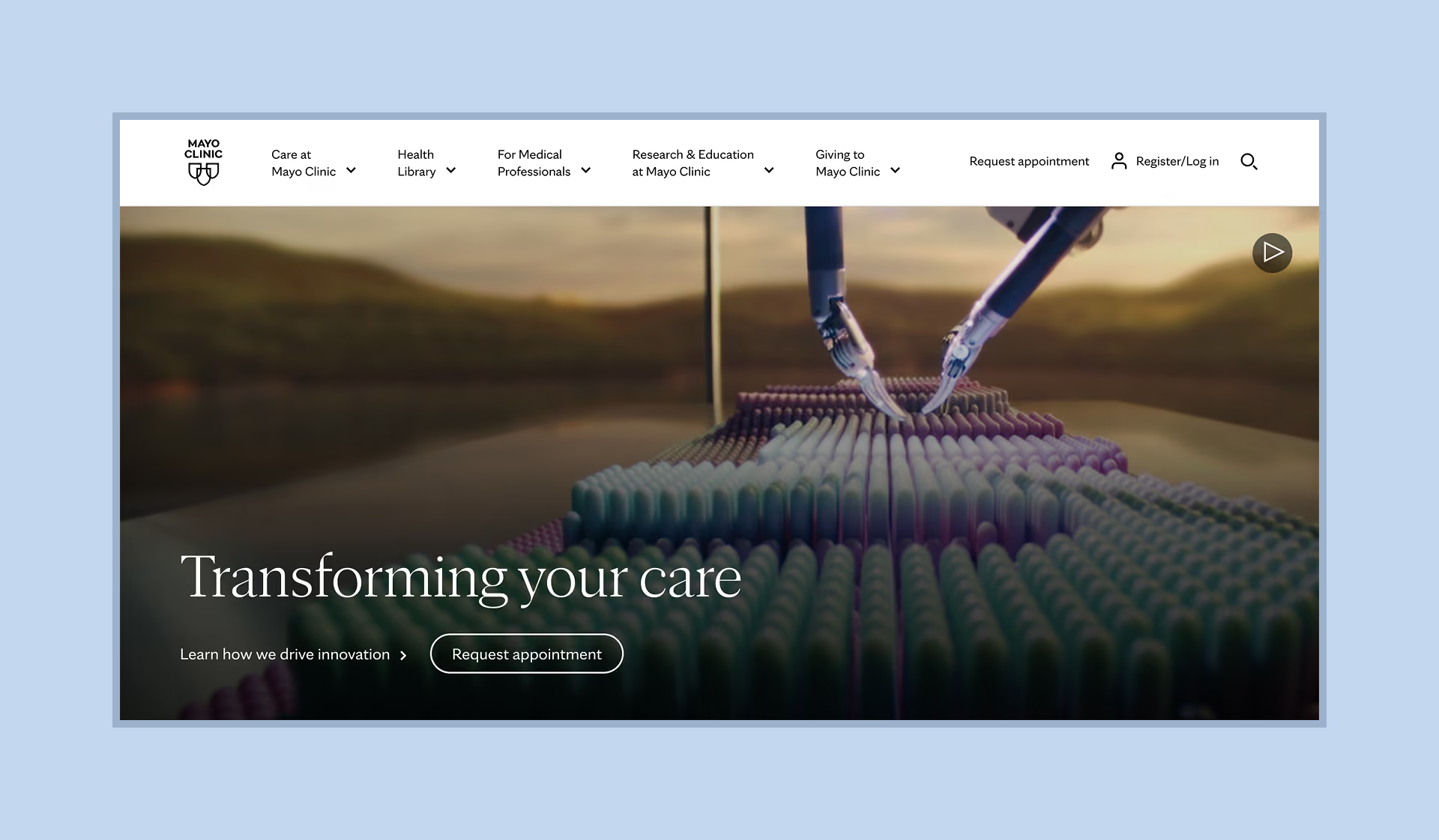
Mayo Clinic, a U.S. academic medical center, builds its brand around one sentence it calls its primary value: “The needs of the patient come first.” Its mission of combining clinical care, education, and research reinforces that commitment, along with values such as compassion, integrity, and respect. Together, they give the organization a consistent message that extends across its services and patient communication.
We-go is a wellness center for mothers and infants in the heart of Asia. To bring its existing identity into the digital space, Halo Lab designed a website that reflects the center’s emphasis on comfort, relaxation, and harmony with nature.
The chosen concept combines beige, olive, and green tones with small red accents, soft arches, and an elegant serif font for Chinese text. These elements create a calm, welcoming atmosphere that reflects the experience We-go wants to offer new mothers.

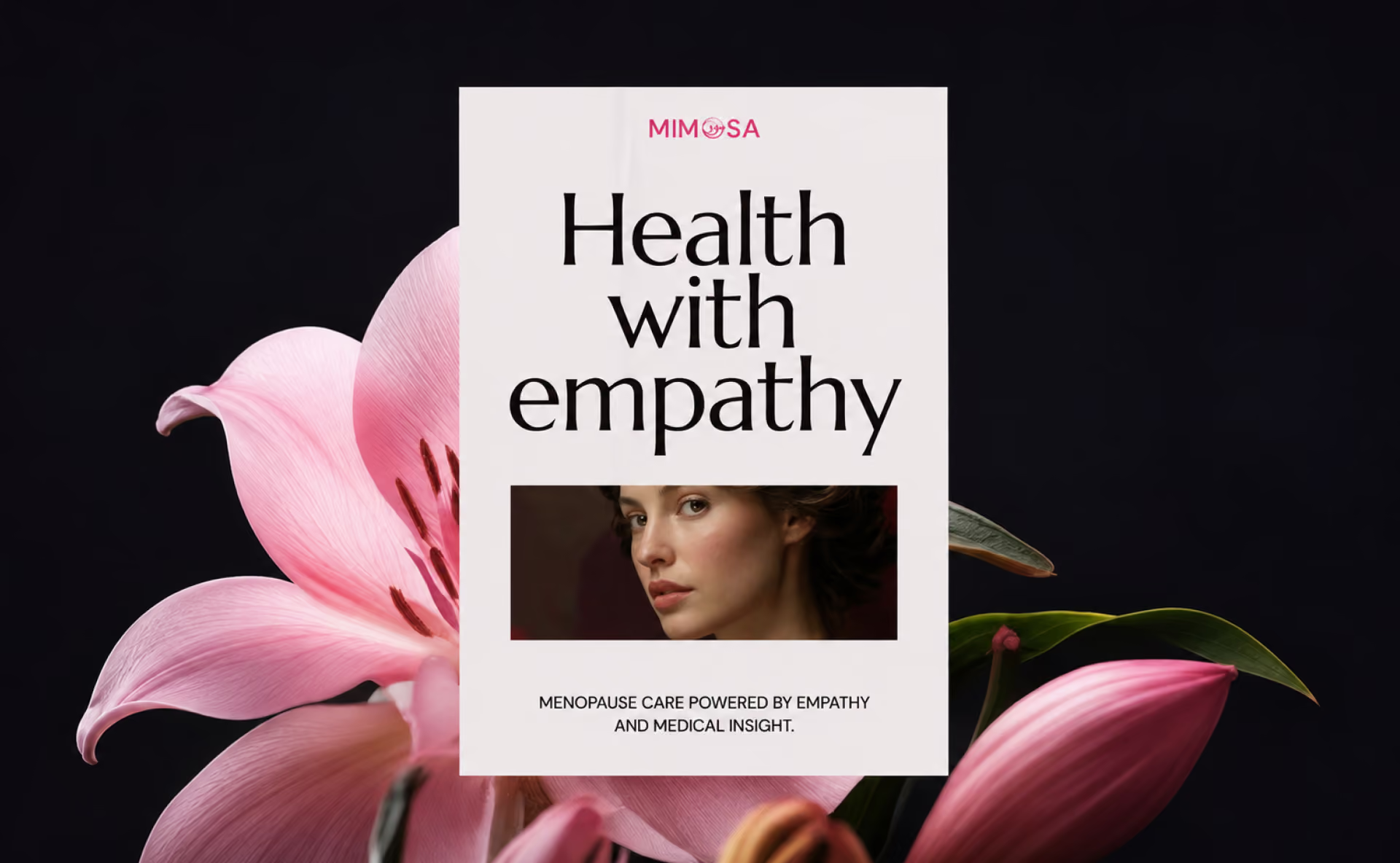
Mimosa is an AI-guided health platform that supports women through menopause. Its brand has to work for individuals, clinicians, and businesses at once. Halo Lab developed confidence- and empathy-driven positioning to communicate medical reliability as well as emotional support.
The identity follows from that promise, including a well-balanced visual language and a logo system inspired by the hormonal cycle. Separate business-facing and consumer-facing sections on the landing page let each audience find its own arguments under one brand.
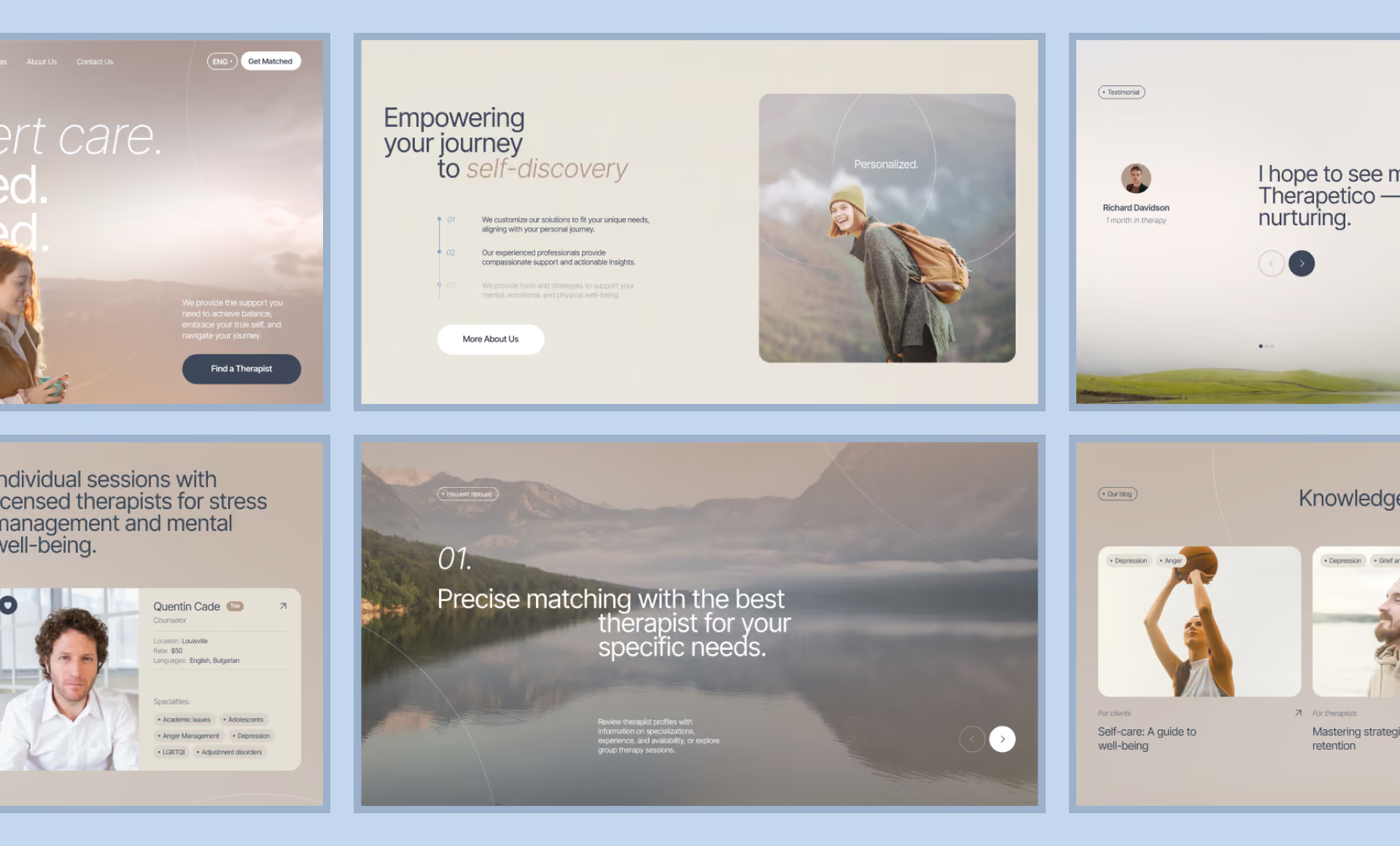
Therapetico is a European therapy platform that connects people with licensed therapists and focuses on long-term therapeutic relationships. Transparent therapist profiles and personalized matching help users understand who they’ll be speaking with before their first session. Halo Lab supported this approach with a reassuring visual identity: a soft beige palette, nature-inspired symbols, and a minimalist bird-in-flight logo, a symbol of personal transformation.
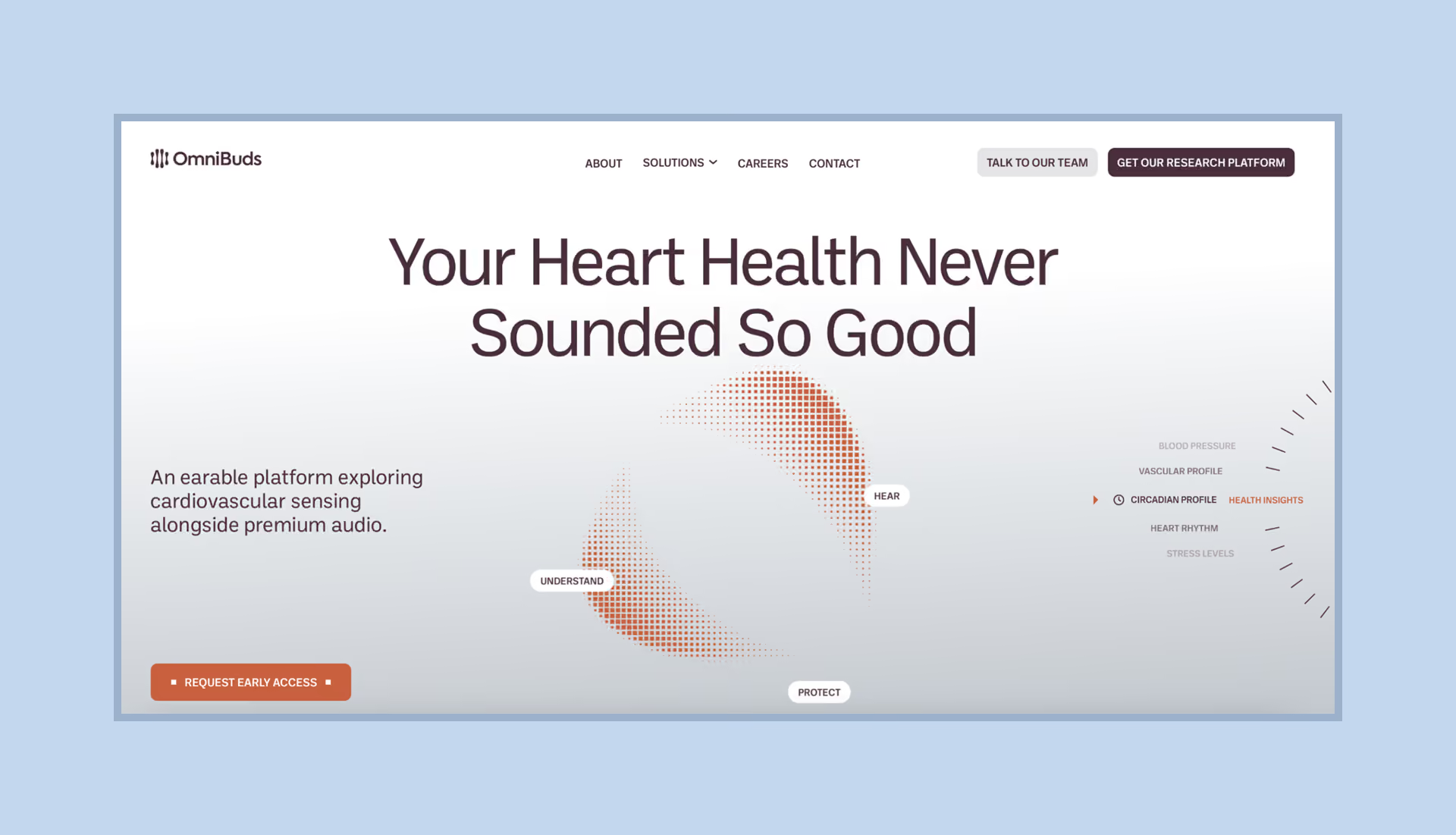
OmniBuds is an ear-worn AI platform for real-time physiological monitoring. As it moved from a research prototype to a commercial product, its brand had to win over investors, healthcare providers, and wellness-focused users.
Halo Lab’s rebranding avoided the clinical aesthetics that dominate medtech, adding burgundy, yellow, and terracotta accents and lifestyle imagery of everyday earbud wearers. We strove to balance innovation with approachability. The logo combines sound waves, earbud silhouettes, and heartbeat patterns, linking the platform’s audio technology to its focus on health monitoring.
A healthcare brand works when what patients see before the visit matches what they experience during and after it. Clear positioning, credible doctor profiles, and a consistent visual identity help people recognize what differentiates an organization among others. But trust ultimately depends on the quality of the patient experience.
For healthcare providers, a good starting point is to check if their brand reflects the care they offer and gives patients enough information to make a confident choice. If those expectations aren’t met, the brand deserves attention before the next advertising budget does.
{{banner-3}}
Healthcare branding defines how a provider is positioned, what it stands for, and what patients can expect. Marketing promotes its services through campaigns, content, and other channels. A clear brand strategy helps keep those messages consistent.
It depends on scope. A visual refresh for a single practice may take a few weeks. Meanwhile, strategy, identity, and rollout for a multi-location provider usually span a few months.
The cost varies with the scope of research, the amount of design work, and how many touchpoints need updating. A small practice may need only a visual identity and website, while a health system may require a full strategy, brand guidelines, and a design system.
Yes. A private practice can stand out through personalized care, specialized services, or closer relationships with patients. Branding helps communicate these strengths, giving patients a clearer picture of what makes the practice different from larger providers.
Usually after a merger, an expansion into new services or markets, or when the brand no longer reflects the quality of care. Patient confusion about what you offer is another common sign.