








A brand can be explained in many ways, especially in today’s marketing landscape. What’s certain, however, is that it has moved beyond being a logo or a trademark and has become a category of consumer thinking. A clear brand strategy brings structure to this perception. It helps businesses act with consistency, intention, and long-term focus.

Assuming that such a strategy is only necessary for large corporations with multi-billion-dollar revenues is a mistake. Whether you’re a startup, a growing business, or rethinking your current direction, having a well-defined approach in place helps define who you are, who you’re for, and how to show up in a way that resonates. Without it, even strong ideas may struggle to make an impact.
This article breaks down the key components of an effective brand strategy and shows you how to build one step-by-step. You’ll learn what strategy looks like in action, why it works, and how to apply it to your business in a way that’s clear, honest, and actionable.
Brand strategy is, at its core, a long-term approach to shaping how your business is viewed in the market. It connects everything — from your visual identity to your messaging, tone, values, and how you act as a company. However, many people confuse brand strategy with brand identity, but they’re not the same thing.
Brand identity represents the visual side of a business. This includes the logo, color scheme, website, and packaging. Brand strategy is what gives those elements meaning. It’s the thinking behind how you present yourself, and why you do it that way.
For a deeper look at building a brand that commands influence in the market, check out our article on brand power. A closer examination reveals how a carefully planned approach shapes perception, unifies messaging, and turns design into a growth driver.
Marketing strategy is about how you promote your products and drive demand. It’s short-term and campaign-based. Such a strategy often relies on analytics to optimize immediate results. Teams executing these campaigns must coordinate quickly across channels to stay effective.
In contrast, brand strategy is deeper. Going beyond quick-turnaround efforts, the focus is on building trust and forming emotional connections. It guides long-term decision-making and helps prioritize initiatives that align with core values. Measuring brand perception over time provides insight into how audiences respond and adapt to your messaging.
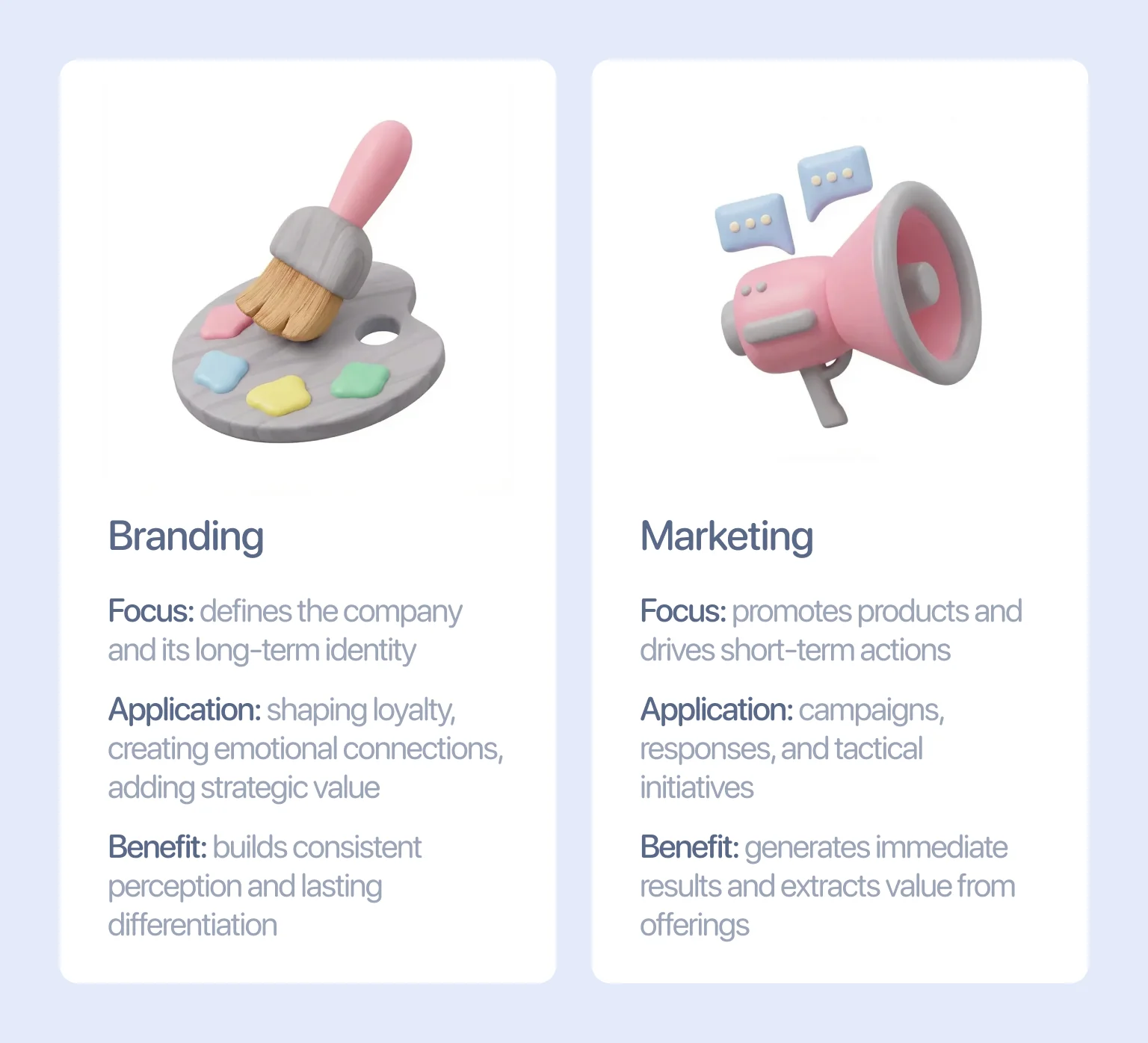
Positioning defines how your brand is perceived in the market. It clarifies what sets your business apart and why those distinctions matter to a specific audience. Brand strategy operates at a broader level. It brings together purpose, values, tone of voice, visual systems, and behavior into a cohesive framework that supports long-term business goals.
In competitive environments, many companies struggle to articulate this framework with precision. Differentiation becomes blurred, and messaging loses consistency as teams grow or markets evolve. This is where strategic branding services play a critical role, helping businesses clarify their value proposition, align internal and external communication, and create a recognizable, credible, and scalable brand system.
A brand with a clear identity and direction is easier to build, grow, and trust. A strong strategy gives your customers and team confidence. Here’s how it pays off over time.
A well-defined brand strategy acts as a decision-making framework. It helps leaders prioritize initiatives, allocate resources effectively, and maintain focus as the organization scales. Rather than reacting to market noise, teams can evaluate opportunities against a clear strategic direction.
In crowded markets, this clarity becomes a measurable advantage. Companies with a strong strategic foundation adapt more easily to change, communicate value with greater precision, and protect their long-term equity. Growth becomes less fragmented and more sustainable, even as markets evolve.
Brand strategy functions as a unifying system across the organization. It establishes shared principles that guide how teams interpret priorities, make decisions, and evaluate success. With a common reference point, collaboration becomes faster, and internal friction is reduced.
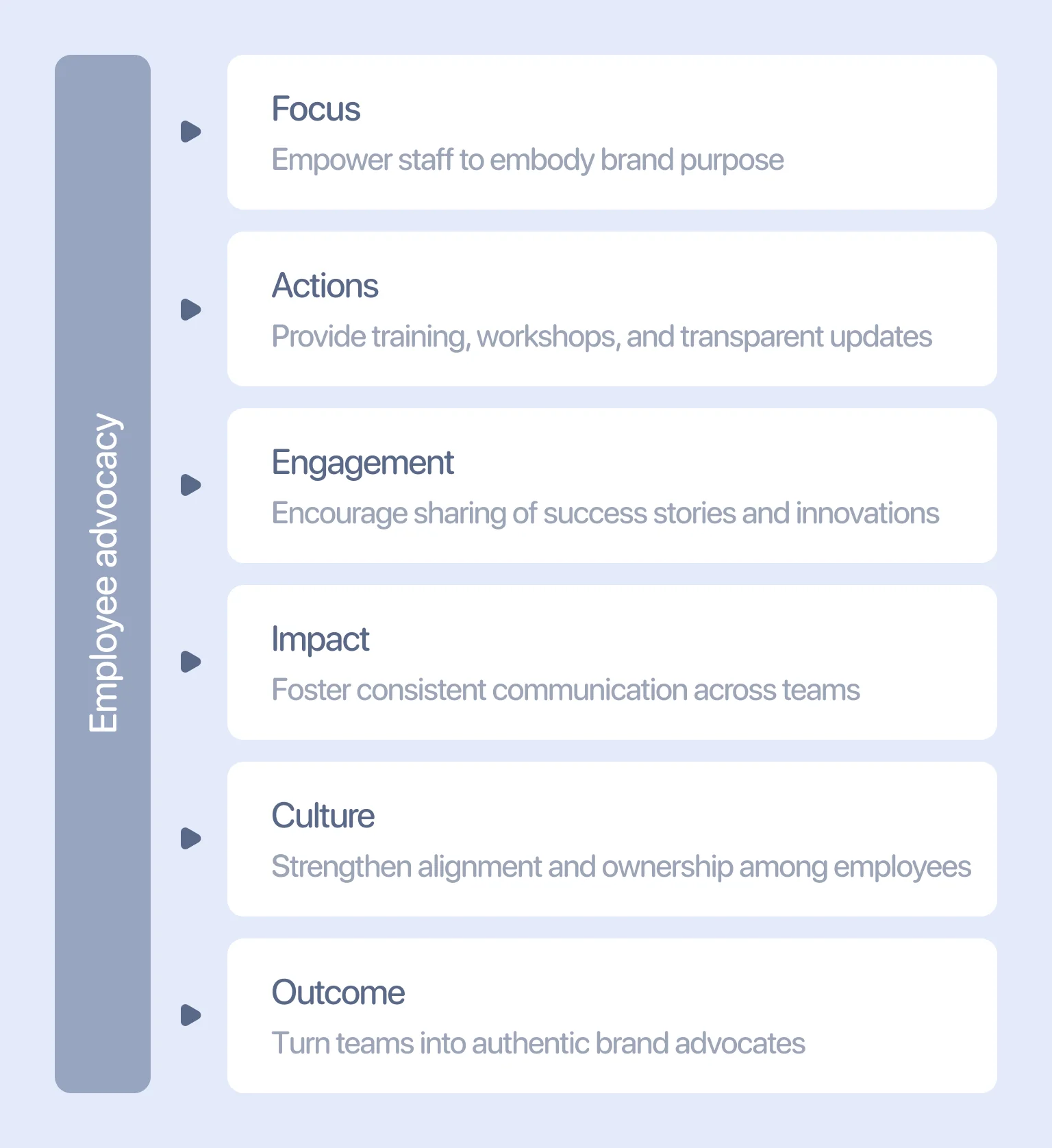
When people understand not just what the brand stands for but why, ownership follows naturally. Teams make more confident choices, communicate more consistently, and reflect the brand’s values in daily interactions. Over time, this alignment turns employees into credible brand advocates, reinforcing the brand through action rather than instruction.
Clearly communicating your brand approach ensures your audience understands what your business stands for and helps you convey this consistently throughout customer journeys. By anchoring your messaging, visual elements, and client interactions in your core values, your company’s purpose will be immediately recognisable.
This coherence strengthens the emotional connection. Customers feel recognized rather than targeted, which increases engagement, repeat interactions, and long-term loyalty. As trust grows, the brand becomes a preferred choice rather than just an option for a one-off transaction.
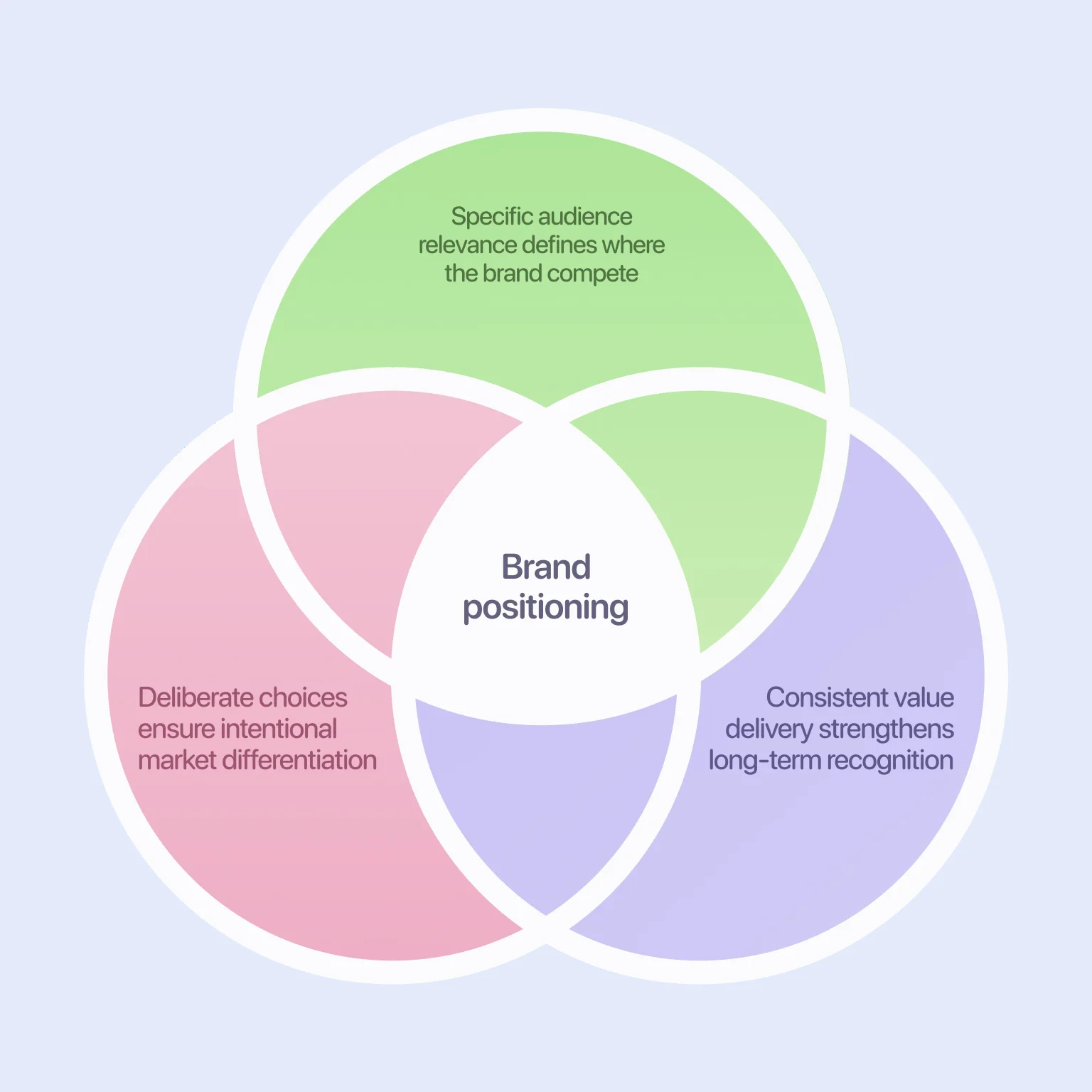
In saturated industries, many companies offer similar products or services, making it difficult for customers to distinguish between them. A strong brand strategy defines where your business chooses to compete and what it deliberately leaves behind. This focus sharpens perception and prevents dilution.
By identifying unmet needs, overlooked gaps, or underserved audiences, brands can claim a distinct position that competitors struggle to replicate. Strategic differentiation ensures that every message, campaign, and experience reinforces why your business exists and why it matters to a specific audience.
Without a clearly defined brand strategy, even strong products and capable teams can struggle to create lasting impact. The absence of strategic direction rarely appears as a single failure. Instead, it manifests as recurring operational and communication issues that slow growth and weaken perception over time.
In practice, organizations without a cohesive brand framework often experience the following symptoms:
Left unaddressed, these issues compound. Communication becomes reactive, teams operate in silos, and the brand loses credibility through inconsistency rather than intent.
Every brand strategy doesn’t look the same. But the most effective ones are built on a few foundational elements. These elements shape how your brand looks, sounds, and performs as you grow.
Purpose explains why the company exists and what role it aims to play beyond financial results. Mission translates that intent into direction by defining what the business is working toward and how success is measured. Values set the boundaries for everyday decisions, shaping behavior, priorities, and expectations across the organization.
Together, these elements create a practical framework rather than abstract statements. They guide leadership choices, influence company culture, and provide teams with a shared reference point. When applied consistently, such a framework helps align internal actions with external communication. It ensures the brand operates with clarity and intent at every stage of growth.
Understanding your audience shapes every strategic decision your brand makes. It determines where to focus, what to prioritize, and which opportunities are worth pursuing. Without this clarity, even well-crafted ideas risk missing the mark or attracting attention from the wrong people.
Effective audience definition goes beyond surface-level traits. It requires insight into context, expectations, and decision-making drivers. When these factors are clear, messaging becomes more precise, positioning gains focus, and the brand can communicate with purpose instead of trying to appeal to everyone at once.
Positioning defines the space your brand chooses to claim in the market. It clarifies what the business stands for, where it competes, and why that stance is relevant to a specific audience. Strong positioning emerges through deliberate choices that focus attention and sharpen perception.
When the direction is clear, differentiation becomes intentional rather than accidental. Teams gain a shared understanding of how value should be communicated and delivered. Over time, this consistency strengthens recognition, supports decision-making, and helps the brand defend its place as markets evolve.
Brand voice defines how a company communicates and how that communication is perceived over time. It guides language choices, sets expectations, and brings consistency to interactions across written content, digital products, and human touchpoints. When voice and tone are clearly articulated, communication feels intentional and coherent.
Consistency turns voice into a system teams can apply with confidence. It reduces ambiguity, supports alignment across channels, and strengthens recognition as the brand grows. When verbal expression works in tandem with visual structure, trust builds naturally. To establish this level of cohesion, brand identity and logo design services provide the foundation for unified systems in which language and visuals reinforce one another and support long-term growth.
Humans process images faster than words, and the first impression often hinges on your brand’s appearance. A thoughtfully designed system includes the logo, color palette, typography, and photography or illustration style.
Design elements must interact consistently across websites, apps, and social platforms. Doing so creates a cohesive visual language that supports your messaging and reinforces audience perception at every interaction.
“Every visual choice communicates intent and creates a memorable impression before a single word is read.”
Some products solve real operational problems yet struggle to communicate their value at scale. Pluto, a UAE-based fintech platform that helps cash-heavy, fast-growing businesses manage spending through smart cards and real-time controls, faced exactly this challenge. As the company prepared to expand into global markets, its brand expression no longer conveyed the clarity, confidence, or ambition of the product. It felt cold, stiff, and regionally limited, which hindered emotional connection and scalability.
Instead of starting with design, Halo Lab approached the company’s transformation from a strategic perspective. The process began with in-depth research and live workshops, which included analyses of regional and global fintech competitors, assessments of digital brand behavior, and insights into finance leaders’ expectations across markets. This process helped identify Pluto’s core values — efficiency, simplicity, trust, innovation, and empathy — and turn them into a clear brand strategy.
With this foundation in place, the brand was evolved rather than rebuilt. The logo was refined to preserve recognition while introducing a more modern, confident character. Visual language shifted away from conventional high-tech fintech cues toward a warmer, more human system, designed to communicate control without distance. Every design decision was tied back to strategy, ensuring coherence across products, marketing, and markets.
The result was a scalable brand system that supports Pluto’s global growth ambitions. Clear positioning, consistent messaging, and detailed brand guidelines now enable teams to communicate with confidence and precision across touchpoints. The case demonstrates how brand strategy, when treated as a business discipline, transforms strong products into brands that resonate, scale, and endure.

The best brand strategies are built in stages — with research, focus, and alignment at every step. Here’s how to create one that actually works for your business.
Start by asking the big questions: Why do you exist? What are your core beliefs? Who is your target audience, and why is serving them important?
Your purpose, mission, and values aren’t just fluff — they guide everything. Knowing what drives your brand helps you make decisions that stay true to your purpose. When your team understands the reason behind your brand, they’re more committed to how it’s carried out.
You can’t position yourself if you don’t understand the industry. These are the key questions you should be able to answer:
For this, ensure to interview real users and analyze reviews. Moreover, dig deep and look at your competitors’ branding, messaging, and product experiences. The goal is to uncover gaps, pain points, and opportunities. If you want to know how to build a brand strategy, this research is where you’ll get the raw insights that shape your edge.
Positioning shapes how people see your brand and why they should pick you instead of a competitor. Your product or service matters, but what truly sets your business apart is how you think, what you stand for, and the unique value you offer.
To get there, ask:
It helps your audience know what to expect and gives your team a guide for making consistent choices.
Why is brand strategy important? Because it pushes you to define what your company is and what it’s not. That focus is what creates real differentiation in a competitive market.
Voice and messaging are what make your brand feel human. And consistent messaging is what creates trust over time.
This framework includes:
The most effective businesses use messaging that sounds unified, even when delivered across multiple channels.
Your visual identity goes beyond logos and colors — it creates a coherent system that guides all design decisions. Every choice, from typography to photography style, contributes to how your brand is recognized and remembered.
Key components include:
Once these elements are defined, document them in brand guidelines. It ensures everyone involved, from internal teams to external partners, applies the identity consistently and accurately.
A brand strategy comes to life only when applied consistently across every touchpoint. Begin by training your team on messaging, visuals, and core values so that communication is unified and purposeful. Review all materials — website, social media, product collateral, and internal documents — and update anything that doesn’t reflect the current direction.
Regularly revisit the strategy to keep it aligned with business changes and audience expectations. Adjust campaigns, messaging, and visual elements based on feedback and performance insights. Continuous evaluation makes your brand remain relevant, trusted, and positioned for sustainable growth.
“Building a brand requires clear purpose, market research, unified messaging, and consistent visual design to ensure lasting impact.”
By this point, you’ve seen how brand strategy influences real decisions, defining who you’re building for, what you stand behind, and how that vision is reflected in messaging, design, and daily execution. When this foundation is clear, teams operate confidently, and products grow with less friction.
At Halo Lab, we translate strategic insights into a brand system that can actually adapt as your business expands. This means you can have confidence in your brand’s direction.
The main goal is to establish focus and alignment. A strong brand strategy outlines what your brand stands for, how it’s unique, and how to communicate that clearly and consistently to both your team and your audience.
How long it takes will vary based on how detailed the work needs to be. A simple strategy might take a few weeks. However, a complete strategy that includes research, visual identity, messaging, and brand guidelines can take between 6 and 12 weeks.
You must include your leadership team, marketing team, design team, and anyone responsible for major brand decisions. It’s also valuable to include voices from different departments and real customer feedback to ensure the strategy reflects both internal goals and external perception.
You should review your brand strategy every 12 to 24 months. It’s also a good time to update it after major changes such as a rebrand, product launch, or market expansion. While your core purpose may stay the same, your messaging and design should adapt as your business evolves.
Yes. Even strong marketing needs clear direction. A well-defined brand strategy keeps messaging aligned, builds long-term recognition, and helps all efforts work toward the same goals.
Some companies skip research, rush the process, or try to speak to everyone. Others create a strategy that sounds good on paper but isn’t usable in practice. A strong strategy must be focused, realistic, and easy to apply across your team and channels.