






Don’t hesitate to try a new look: evolution doesn’t mean erasing everything you’ve built. Many are unable to grasp the brand refresh vs. rebrand dilemma and which best supports their business growth. We’ll break down how each approach helps your identity evolve strategically while preserving the company’s essence.

Every brand faces a moment when it needs to mature, but what if the new logo causes us to lose the hard-earned recognition that took years to create? That’s why choosing between a refinement and a reinvention is a pivotal decision. While the former is about maintenance, the latter involves redefining your whole story. Our guide compares these options side by side, so you won’t accidentally erase your brand identity.
Such an approach is like giving your house a fresh coat of paint to achieve a more current look rather than tearing it down to the studs. Similarly, a strategic tune-up for your brand typically involves updating elements, including the logo, typography, or color palette, to keep abreast of trends. The core identity remains intact — only the appearance changes, so you can remain relevant in an evolving business environment. For a deeper look at what underpins this kind of evolution, explore our brand strategy guide.
From a marketing perspective, a brand refresh helps you stay ahead of the competition by adapting to audience expectations. What was regarded as efficient in 2020 may feel outdated at the moment, and a few tweaks here and there can breathe new life into your presence. Hitting the update button allows you to signal to everyone that you’re still alive and kicking, without confusing loyal customers.

This approach involves a strategic transformation of a business’s identity. Unlike a refresh with subtle updates at the surface level, a rebrand redefines the foundation — the target audience, positioning, and the company’s voice. Such a path is often driven by major shifts, pushing you to stand out while also enhancing your presence. Maybe you’re entering a new market or merging with another firm; the considered transformation replaces the old perception with a completely fresh one that aligns with your future direction.
If that’s the path you’re embarking on, use rebranding services to clarify and strengthen a company’s identity while ensuring core elements receive strategic backing. Such support streamlines the process of redefining brand components, making the transition efficient and coherent. The resulting identity remains authentic and strategically positioned for long-term growth.

These two strategies differ in scope and underlying intent. A refresh emphasizes refinement, whereas a rebrand centers on long-term repositioning. To know which one is right for your business, let’s look at a broader comparison.
Things usually start with defining the underlying goals. A refresh is often triggered by the need to make your look more refined and updated, adapting to minor shifts in customer expectations. In contrast, rebranding is the result of foundational changes where your current branding no longer reflects the business.
That clarity comes from a detailed brand analysis of positioning, customers, and competitors, which reveals whether refinement or a deeper strategic realignment is truly needed.
The key distinction between the two lies in the extent of alteration involved. A rebrand introduces a fundamentally new identity. By contrast, a refresh refines existing elements — adjusting visuals, revising tone, and enhancing presentation — while ensuring core elements receive strategic backing. Ultimately, the decision depends on how profound a transformation your business requires.
If you’re looking to unify visual identity, strategic messaging, and communication systems into a cohesive framework, our branding services can bring all of that together across every touchpoint.
A refresh signals that you’re current by preserving familiar elements while refining the visual language for stronger engagement. A rebrand, however, communicates a fundamental shift, reshaping how the company is perceived and unlocking access to entirely new segments. Results may fluctuate initially, but when the transformation is strategically planned and executed, long-term growth typically follows.

In most cases, a refresh is completed relatively quickly, with some initiatives finalized in just a few weeks. Its scope is largely limited to visual and verbal refinement. A rebrand, by contrast, demands in-depth research, strategic alignment, and a carefully staged rollout that may extend over months or even years. Existing elements are systematically phased out to make way for the new identity.
The more cost-effective method is a refresh, since it requires fewer resources and less disruption to the business. Rebrands generally demand larger budgets for research, design, and marketing to ensure the new identity is well-received upon launch. The expected cost for a full-scale project might be three times higher than a refresh.
Businesses often risk making changes too subtle, leaving an insignificant impact when revitalizing their image. The stakes are higher for rebrands. If the change feels too abrupt, loyal customers might be confused, leading to weakened trust. In the worst cases, you may find yourself polishing what needs to be replaced or abandoning what should be kept.
A refresh is the more cost-effective path, requiring fewer resources and less disruption to the business. Based on typical agency pricing, refresh projects generally range from $15,000 to $60,000, depending on scope. Full rebrands demand significantly larger budgets — covering research, strategy, design, and phased rollout — and commonly run from $50,000 to $500,000 or more for mid-sized businesses and enterprises.
The gap reflects not just design work but the strategic depth, audience research, and implementation complexity a rebrand requires. Treating either as a purely aesthetic expense rather than a strategic investment is where most budget decisions go wrong.

A refresh is the perfect call if your brand identity feels a bit off, yet core values and positioning remain strong. The logo can be resized for smaller screens, and the palette brightened so that the website doesn’t appear faded compared to competitors. This signals growth and relevance while holding on to your equity.
For early-stage companies building their identity for the first time, exploring startup branding tips provides actionable advice on how to keep a brand fresh and flexible for future scalability when the business expands.
Bookclub24, the leading German online library for book collectors, is a clear example of this in practice. When the platform came to Halo Lab, it held a strong market position across Germany, Austria, and Switzerland — but its design system had become inconsistent, mobile responsiveness was limited, and the visual language no longer fully reflected the brand’s core concept.
The positioning and audience were right. The fundamentals were sound. What needed attention was how the brand was expressed across touchpoints. We refined rather than replaced — bringing consistency to the design system, aligning visuals with the brand’s identity, and improving usability. The platform retained both its recognition and its market position, while evolving to meet modern expectations. For a closer look, explore the full Bookclub24 case study.
If the fundamentals are strong, strategic refinement is more powerful than radical change, because it strengthens relevance while preserving established equity.
If your current branding no longer reflects the company you’re actually running, it’s time to reconsider the identity entirely. A significant gap between how the brand is perceived and what the business has become signals that minor updates won’t suffice.
This situation often arises when companies enter a completely new market, adjust their product offerings, or evolve beyond their original mission and values. Taking a step back allows you to evaluate what truly represents the business moving forward.
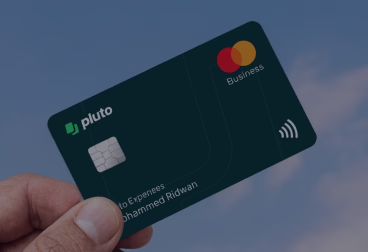
Pluto, a UAE-based fintech platform, is a good illustration of when a full rebrand becomes necessary, as shown in the Pluto case study. The company had built strong recognition in the Middle East as a corporate card solution — but as it expanded into North America and grew into a comprehensive spend management ecosystem, its existing identity no longer reflected that scale or ambition.
When Pluto came to Halo Lab, minor updates clearly wouldn’t have closed that gap. We approached the project as a full strategic reset, redefining positioning, brand voice, and digital presence from the ground up. The result was an identity built not for where Pluto had been, but for where it was heading.
Refreshing or rebranding, there’s something that must be protected at all costs in either case. These permanent elements make your brand feel consistent and trustworthy. Changes are not equal to destruction, and here’s what must remain steady:
Even when you’re carrying out a full-scale rebrand, the emotional outcomes that you’ve promised to deliver must stay consistent. Nike isn’t just about sneakers but about empowering athletic performance. Hence, a refresh should amplify your essence, while a rebrand should rewrite it in a different context.
Both approaches put customers at the heart of every branding decision. You need a clear understanding of their needs and preferences, and show them how they fit into your story. Without this insight, you risk alienation. Listen to your audience.
Neither a refresh nor a rebrand should replace your long-term purpose. The reason your company exists — whether to develop cutting-edge sports gear or to provide affordable, clean energy to every household — must survive any aesthetic overhaul or reinvention. To get some inspiration on how to design frameworks that foster business strategies, learn more from the top 14 brand design systems.
Before launching a new look or an entirely different identity, the internal team must be the first to embrace the change. This is what corporate alignment is about — ensuring every employee understands the updated story and how their daily work reflects it. Only when your team is aligned does the external rollout become successful.
A refresh or a rebrand may alter how your company looks and speaks, but the core promise, strategic intent, and internal cohesion must stay consistent.
Businesses often confuse these two approaches, resulting in the waste of valuable resources on an ineffective action plan. Opting for a full rebrand when only minor tweaks are needed can jeopardize customer loyalty.
Conversely, if you choose to apply a small refresh when a complete transformation is required, your brand may stall. Ultimately, it boils down to identifying the current pain points of your company and selecting a path that addresses them.

Still torn between the two options? Run through this checklist to guide your decision:
By answering these four questions honestly, you can select the correct roadmap for your brand. If most answers point toward a refresh, sharpen your competitive edge while preserving what’s working well. Otherwise, retire everything that doesn’t fit and build from scratch with a focus on brand identity design.
Differentiating a brand refresh vs. rebranding is only the first step in a long journey for your company. Small choices along the way can influence perception and growth. Every decision should account for both market expectations and internal capabilities. Thoughtful planning helps ensure changes are purposeful rather than arbitrary.
A branding refresh helps modernize your identity without sacrificing recognition, whereas a rebrand renegotiates this to match the actual business. Approaching such transformations carefully ensures your company evolves consistently and remains relevant as markets and audiences change.
{{banner}}
Yes. A refresh of minor updates might be conducted once every few years to keep your brand current. But over time, if market shifts or business goals require bigger changes, a fundamental rebrand will be necessary at some point.
Absolutely. A refresh can focus on any elements, such as typography, messaging, or colors. While a logo carries weight and appears across platforms, you don’t have to change it just for the sake of refreshing. Don’t fix what isn’t broken.
The success of refreshes is often measured through different metrics, including customer perception, engagement, and conversion rates. For rebrands, look at business awareness, sentiment, and ROI. You can gain valuable insights by tracking the project KPIs, depending on your ultimate goals.
Generally, a refresh is considered much safer because it only updates execution without disrupting familiarity. However, “less risky” doesn’t mean “right.” Established companies with a malfunctioning identity can face more severe consequences in the long run if they continue postponing a full rebrand.
Brands should perform a strategic review of their identity every three to five years. The market is moving faster and faster in 2026, so revisiting often enough allows you to stay proactive. A light annual audit is also recommended to identify gaps before they turn into major failures.