






Getting to know your users often requires looking past the obvious statements they share during interviews or surveys. Although specialists gather research, the real value comes from putting those insights together. Using a structured approach is like assembling a puzzle, where scattered observations come together to reveal the full picture.

To build a truly successful product, design teams need to step into their clients’ shoes — capture their unspoken needs, motivations, and pain points. Do you want to transform abstract data into tangible insights? Are you trying to get a better grasp of your target group? This is where an empathy map comes into the picture. We will guide you through the mapping process, benefits, and strategic application. So let’s not wait any longer and start with the essentials!
Far from a static document, an empathy map is a dynamic research artifact that breathes life into your personas and drives informed decision-making throughout the entire project lifecycle. To understand what an empathy map is in design, we must look at its structure.
Basically, it’s a collaborative visualization tool designed to articulate what a group learned about a specific audience segment. In human-centered design, it’s a powerful way to reveal attitudes, motivations, and frustrations that basic research notes may not always capture.
At its core, an empathy map UX serves as a graphical representation that helps to internalize consumer perspectives. Simply put, by making research findings public, experts create a shared reference point that keeps discussions and decisions on the same page.
“The more deeply you know your users, the more effectively you can solve their problems.”
This map acts as a bridge between raw data — gathered from interviews, observations, and field studies — and actionable insights that inform design and development. The aim is not to collect isolated traits but to combine them into an integrated view that supports meaningful solutions.
It might seem that creating a custom empathy map for your product is time-consuming and costly. However, it’s more than a documentation exercise. Let’s call it an investment in more detailed user insights that directly translate into better product-market fit and improved user satisfaction.
A detailed map equals clarity on the client’s needs. Otherwise, they will remain hidden and lead to costly assumptions and rework later in the development cycle. This process helps bring your users’ insights out into the open and organize them, so everyone, from designers to developers to marketers, is on the same page. Being on the same page results in decisions that truly resonate with your audience. Remember that delighted users don’t come from product core features alone.
These insights don’t exist in isolation — they feed directly into your broader product design strategy. If you’re refining flows, validating features, or rethinking the entire experience, understanding your users at this depth becomes the foundation of effective UI/UX design.
Furthermore, a custom map helps identify areas where your product can provide unique value, distinguishing you from competitors. It grounds your product strategy in real user experiences, making it a powerful asset for growth and innovation.
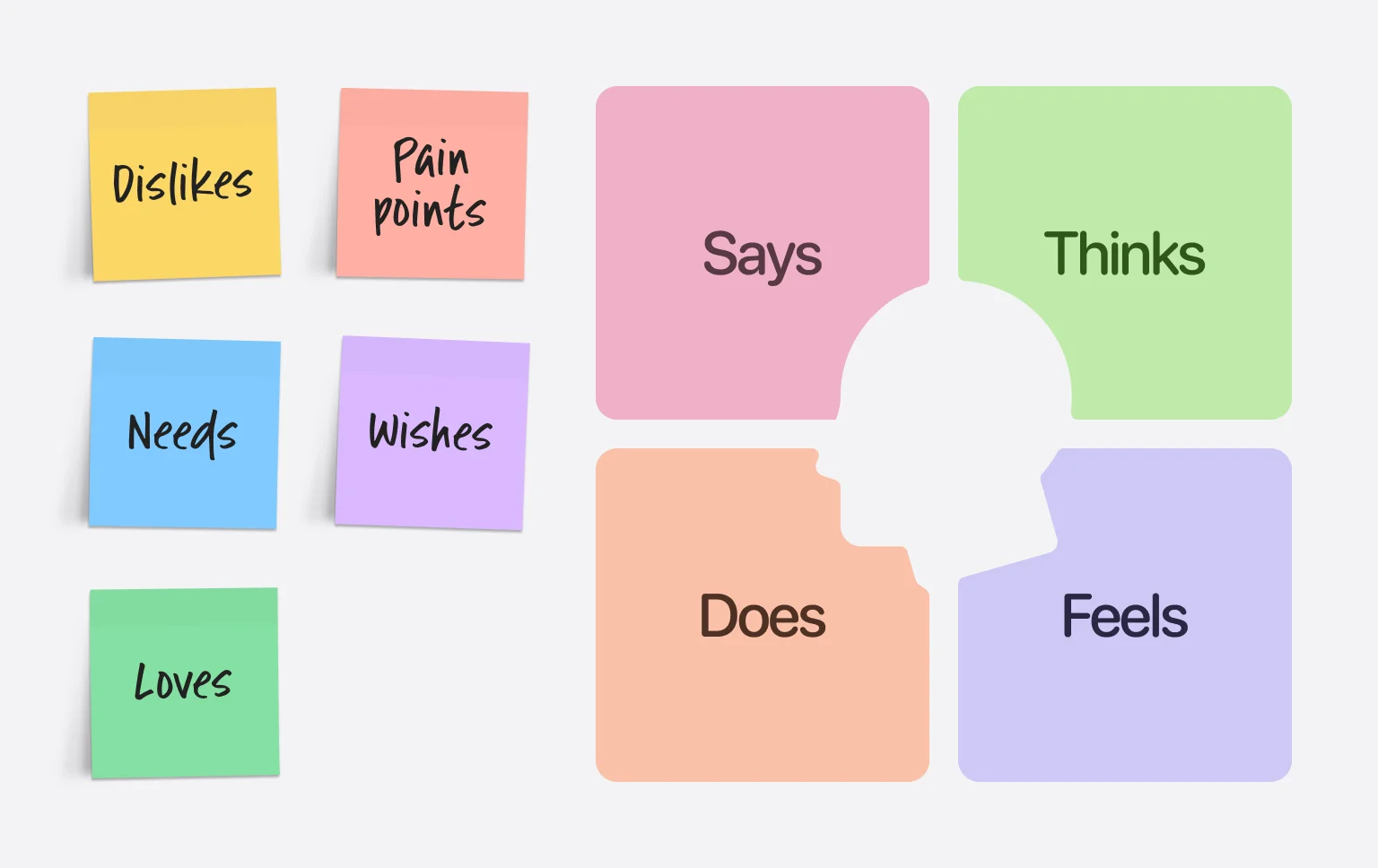
The empathy map usually includes four main quadrants. Each one represents a different aspect of the person’s experience behind UI/UX design that converts. They let practitioners sort and interpret observations in a way that paints a full, holistic view of the person. So, given how important each section is, let’s take a closer look at them.
Section “Says” captures everything the respondent shares during interviews, observations, or feedback sessions. It includes explicit statements and direct quotes that reveal their opinions, frustrations, desires, and experiences. Here, you should focus on transcribing exact phrases rather than paraphrasing. The precise wording often carries significant meaning and tone. This ensures the subject’s perspective is represented exactly as they expressed it, without any interpretation.
Section “Thinks” uncovers what the person is thinking or worrying about, including their unspoken thoughts, beliefs, and internal monologues. “How do I know what people think?” you might ask. Of course, these inferred thoughts, assumptions, and motivations might not be openly expressed, but you can still notice them. Pay attention to individuals’ body language, context, and responses to indirect questions. You should try to understand the thought processes and mental models that guide their actions.
Section “Does” requires attention to the person’s actions, behaviors, and habits in relevant situations. It is yet again about being attentive. Notice how individuals interact with goods or services, their daily routines, and their physical behaviors. This could involve clicking patterns, navigation choices, tasks performed, or even non-verbal actions observed during consumer research. Overall, you should focus on real actions and interactions you can see and measure.
Section “Feels,” as you might already have guessed, captures a person’s emotions, moods, and underlying motivations. Here, you must connect with your clients on a deeper emotional level — whether they feel frustrated, happy, anxious, excited, bored, or confused. This way, you connect the dots between the emotions, behaviors, and thoughts. When you do it, you realize what delights or frustrates the audience.
While empathy mapping is a powerful tool for consumer research and design thinking, it’s essential to pay attention to both its strengths and limitations. Doing it ensures that your efforts yield the most valuable insights for your project.
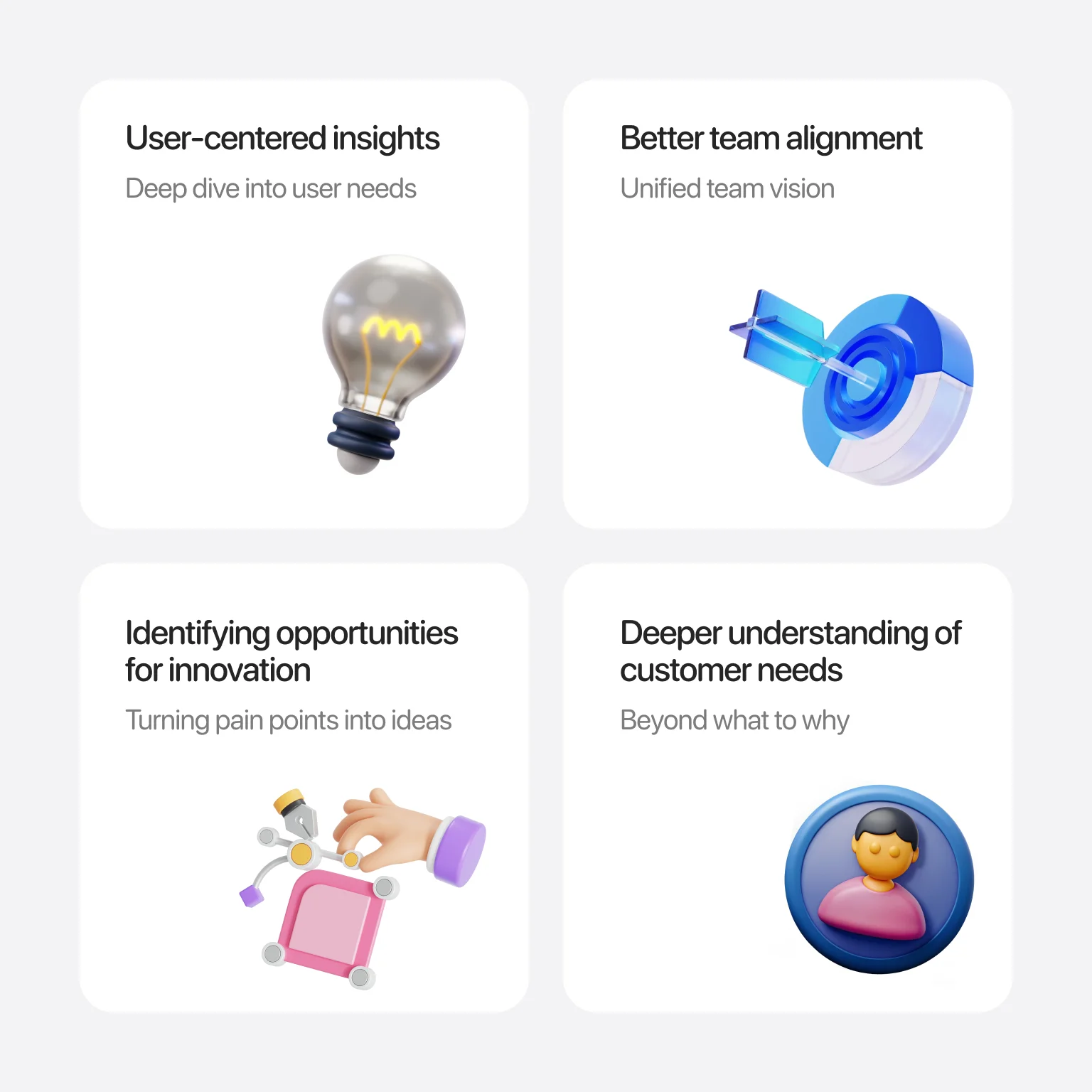
Among the benefits of empathy mapping are user-centered insights, better team alignment, identification of opportunities for innovation, and a better understanding of customer needs. They help you build a solid foundation for human-focused design. Let’s take a closer look at these advantages:
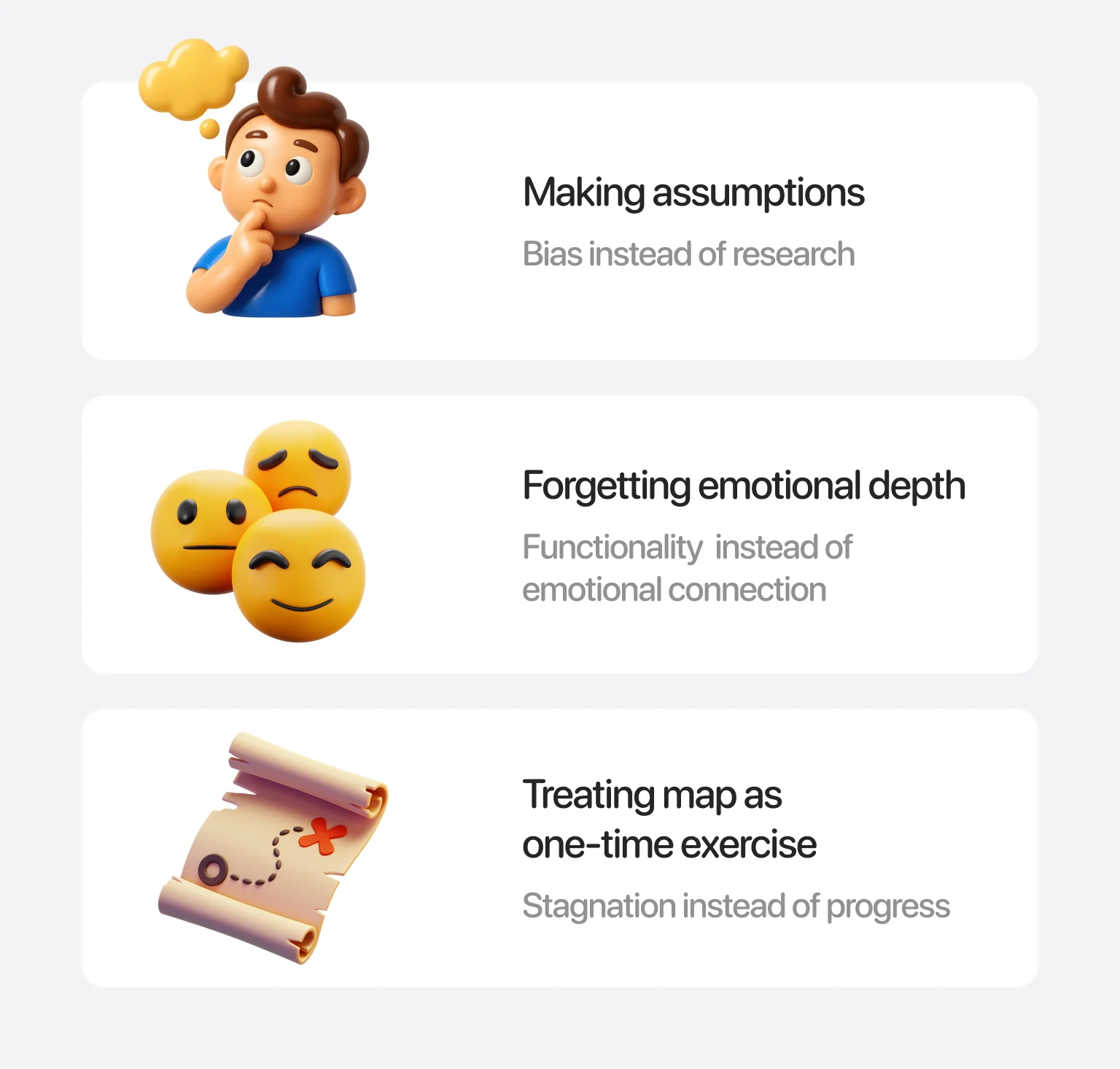
Even with all its benefits, the mapping process still comes with a few possible drawbacks. It’s time for you to learn them, too:
“Your customer’s empathy map should be a synthesis of evidence instead of conjecture.”
The empathy map is versatile and applicable at various stages of the item development lifecycle. Its strategic deployment can provide clarity, guide decisions, and ensure human-centricity when it matters most. So, when should you use it? Read on to find out!
“Empathy is seeing with the eyes of another, listening with the ears of another, and feeling with the heart of another.” Alfred Adler
When squads are trying to understand the problem space and the target market, empathy mapping is invaluable for laying a strong foundation. First, it brings together scattered research, interviews, and observations into one clear view of the person’s experience. Second, it helps teams spot unmet needs, challenges, and opportunities together, making sure the ideas that follow are rooted in real human problems. For teams beginning this process from scratch, structured product research services can accelerate discovery. And just with this little extra help, the insights feeding your empathy map are complete, unbiased, and actionable.
Before diving into prototyping and wireframing, using a psychological profile helps validate and refine proposed design directions. By checking design ideas against what the person says, thinks, does, and feels, designers can spot usability issues early. It also helps identify where a concept might not align with the user’s expectations or emotional needs.
If you are currently on the stage of early testing, check out our article What is a UX prototype in design.
Even after a service has been launched, a customer empathy map remains a powerful tool for continuous improvement. Post-launch feedback, analytics data, and support tickets can be used to update and refine the visual. There are three positive results here:
It provides a framework for interpreting live interaction data and identifying future enhancements or new feature development based on real-world usage.
If you feel unsure at any of these stages regarding your current audience portrait and strategies, consider conducting a web design audit. And for guidance on overarching user experience planning, you can explore our insights on UX strategy.
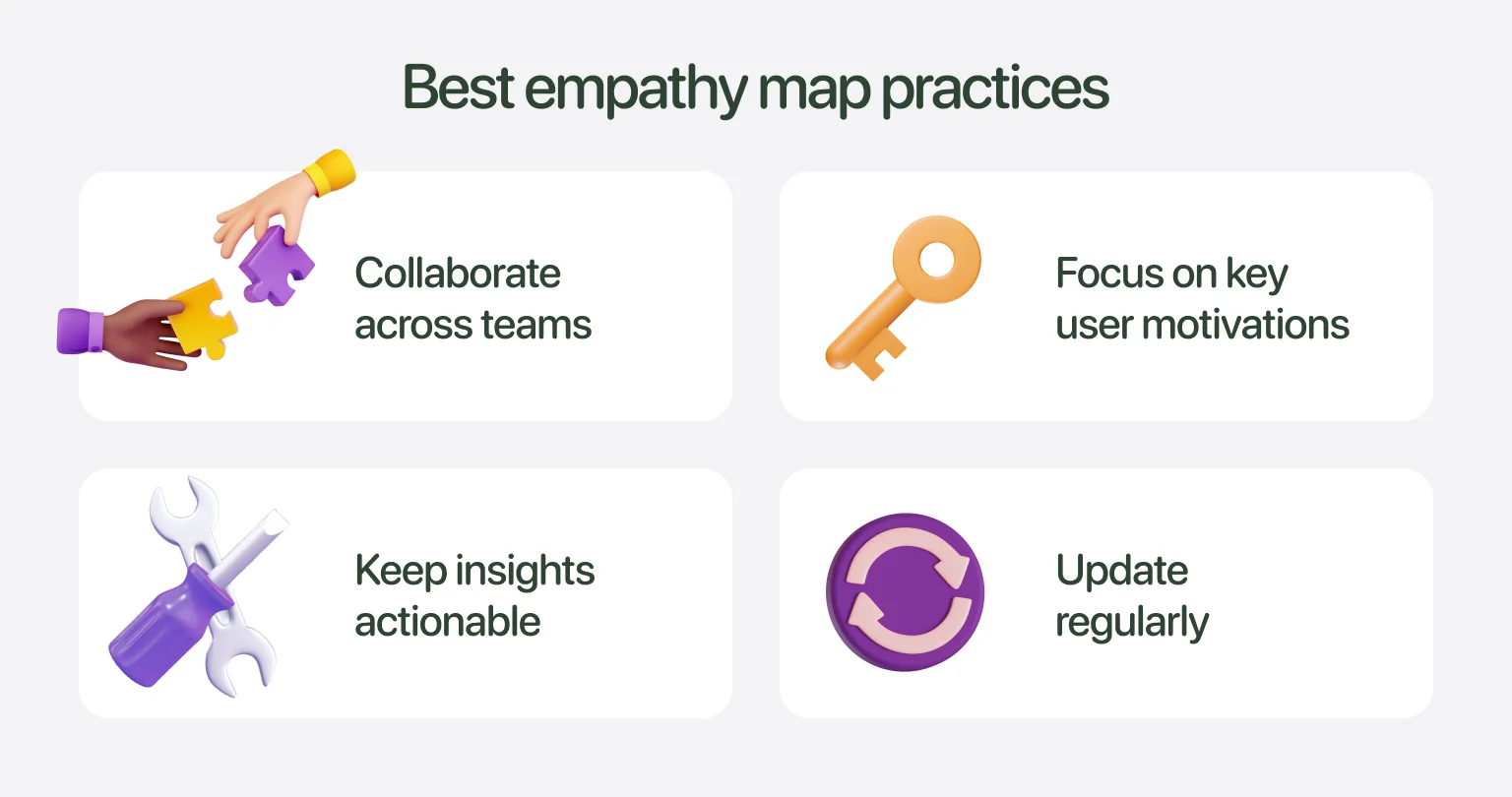
When you’re learning how to create an empathy map, you should be using the best practices out there. They’ll help you make meaningful, actionable maps that’ll really influence your offering strategy. We’ll go through some of them here.
Empathy mapping is most effective when it’s a collaborative effort involving diverse stakeholders. You should bring together designers, managers, developers, marketers, and even sales representatives. Each contributor offers a unique perspective and insights into the purchaser. This practice enriches the visual, fosters shared understanding, and builds consensus around the persona, preventing isolated decision-making.
The next step is to resist the urge to fill the template with every single detail. Instead, concentrate on the most important human motivations, pain points, and goals. This keeps the schematic clear and practical. And you can easily see the key elements that will guide your design and development decisions.
The ultimate goal here is to generate insights that lead to tangible improvements. As you progress with your empathy map, constantly ask: “What does this tell us about what the consumer needs?” and “What solutions can we design to address this?” Present your observations so they clearly guide design choices, help prioritize features, or inform strategic planning.
A profile is not a static document. Audience needs and market contexts evolve. That’s why you should regularly revisit and update your chart based on new research, feedback, and item iterations. Think of it as a garden that grows and changes as you learn more about your customer — each update is like watering or pruning to keep it healthy. This ensures your solution strategy remains relevant and responsive to changing human behaviors and emotions.
Both the customer empathy map and the journey map are essential in design thinking, as they serve different purposes and offer unique perspectives. Knowing what each does best and how they work together is crucial for a complete human-centered approach.
The former focuses on the individual’s internal world at a specific point in time. It’s about understanding who the person is, and capturing their “says”, “thinks”, “does”, and “feels” in relation to a particular experience or problem. It’s a snapshot, aiming for profound psychological and emotional insights into a subject’s mindset.
Conversely, a customer journey map illustrates the user’s experience over time as they interact with a brand to achieve their goal. It details the steps, touchpoints, channels, emotions, and pain points experienced across various stages, from initial awareness to post-use. It answers how the participant interacts and what their entire path looks like.
“A journey map tells the story of experience, while an empathy map reveals the soul of the traveler.”
In essence, the psychological profile helps you realize who your buyer is and why they behave the way they do. The journey map shows what they do and where they go over time, detailing the sequence of their interaction. Used together, they make the journey more relatable. To further differentiate these tools, check out our article Experience map vs. customer journey map.
| Empathy Map | Journey Map | |
|---|---|---|
| Focus | Internal world: says, thinks, does | External path: stages, touchpoints, channels |
| Time perspective | Snapshot at a specific moment | Timeline from first contact to post-use |
| Main question | Who is this person and why do they feel / act this way? | How do they move through the experience over time? |
| Typical content | Attitudes, motivations, fears, needs, frustrations | Steps, goals, emotions per stage, pain points, opportunities |
| Best for | Deepening empathy and psychological insight | Designing and improving end-to-end journeys |
Empathy maps can be applied across various industries and product types to gain a detailed picture of specific audience segments. Here are a few practical empathy map examples to show you how any project can benefit from it.
Imagine a new SaaS subscriber attempting to set up an account and integrate a new system. What are their “says”, “thinks”, “does”, and “feels”? Let’s find out!
Insights like these often shape the foundation of effective onboarding flows — an area where specialized SaaS website design services can make a significant difference.
The next example comes from e-commerce. Consider a shopper browsing an online store for a new pair of running shoes. The empathy map will look like this:
What conclusions can we draw here? Сustomers need detailed merchandise descriptions, clear sizing guides, buyer-generated content (reviews with photos), and transparent shipping policies to address anxieties and build trust. Addressing these concerns is essential for reducing friction and improving conversions — a core focus of our e-commerce website design services.
If you work in mobile app development, think of a person trying to find a restaurant using a new food delivery mobile app, and check out the empathy map of this client:
This insight might lead to design improvements such as streamlined filtering, personalized recommendations, clear delivery time estimates, and visually appealing menus. Reaching such results often requires rethinking navigation, hierarchy, and decision flow — areas where thoughtful mobile application design services can elevate the entire user experience.
The last practical example comes from the digital health sector. Imagine a person tracking their fitness goals with a new health app. Here is what their empathy map can look like:
Looking at this example, it’s clear that customers want to see their progress in a way that’s easy to understand and actually motivates them. They’re looking for goals that feel personal to them, data that doesn’t require a PhD to interpret, and little nudges along the way to keep them going. Since health data can overwhelm users quickly, designing interfaces that reduce cognitive load and highlight meaningful insights is essential — a priority in our healthcare UX/UI design services.
An empathy map is a fundamental step toward building a solution that truly resonates with its users. It provides a robust foundation of understanding, allowing your staff to move from assumptions to informed, people-centered solutions. Getting to know your customers on a deeper level — their frustrations, habits, worries, and words — helps you spot what you’re really missing. That’s where the magic happens: you can create better solutions, and your whole team gets on the same page about who you’re helping.
Sure, turning customer feedback into something meaningful isn’t easy, but when you have a full picture of who your customers are, it’s like finally having the cheat codes. If you’re ready to turn these insights into a product roadmap with real impact, our team is here to support the next step. Just reach out through our contact page to get started!
Typically, a cross-functional squad creates these visuals. This often includes UX designers, product managers, researchers, marketers, and even developers. The collaborative nature of the exercise ensures diverse perspectives and a shared view of the individual.
Absolutely. While often associated with consumer goods, empathy diagrams are highly effective for B2B projects. B2B clients are still individuals with emotions, challenges, and goals. Understanding the professional (e.g., a procurement manager, an enterprise administrator) and their workplace pain points, organizational pressures, and aspirations is crucial for designing and selling successful B2B solutions.
The time required can vary. A basic profiling exercise based on existing research might take a group a few hours. However, if it involves extensive primary audience research, such as interviews and observations, the overall process can span several days or even weeks.
Absolutely. It lets you base your strategy on real customer needs and behaviors, not assumptions. By grasping buyer challenges and motivations, you can prioritize features, create stronger value propositions, and focus resources for maximum impact.
It should be updated whenever new significant market research emerges, major solution changes occur, or new buyer segments are targeted. Ideally, it should be revisited at key initiative milestones or at least every 6–12 months.
Yes, we can use your existing research (market studies, analytics, and customer feedback) to build a detailed audience profile, filling any gaps with fresh research. You’ll walk away with a strong insight that changes how you connect with your target audience.


.avif)