








Microservices are made to solve the fast-growing complexity of software projects, though they are not a complete or perfect solution. They come with clear benefits and drawbacks, and depending on the project, either can prevail.

Attitudes toward microservices vary. Some genuinely admire them, while others criticize them just as strongly. Paradoxically, both sides are right. In this article, we’ll take a closer look at the advantages and disadvantages of service-oriented architecture, so you can decide whether it makes sense for your project. But before we get into it, let’s take a step back and look at where this term came from.
If we look at the history of microservices, one thing becomes clear: they did not appear as a trend or a technical whim. Back in the day, most applications were built as monoliths: a single codebase where the user interface, business logic, and database access were tightly coupled. This approach was simple and worked well for small projects and teams.
However, as products and organizations grew, monoliths began to reveal serious drawbacks: even small changes risked breaking the whole system, deployments were slow, and scaling specific features was a headache. The need for a more flexible and resilient architecture became obvious.
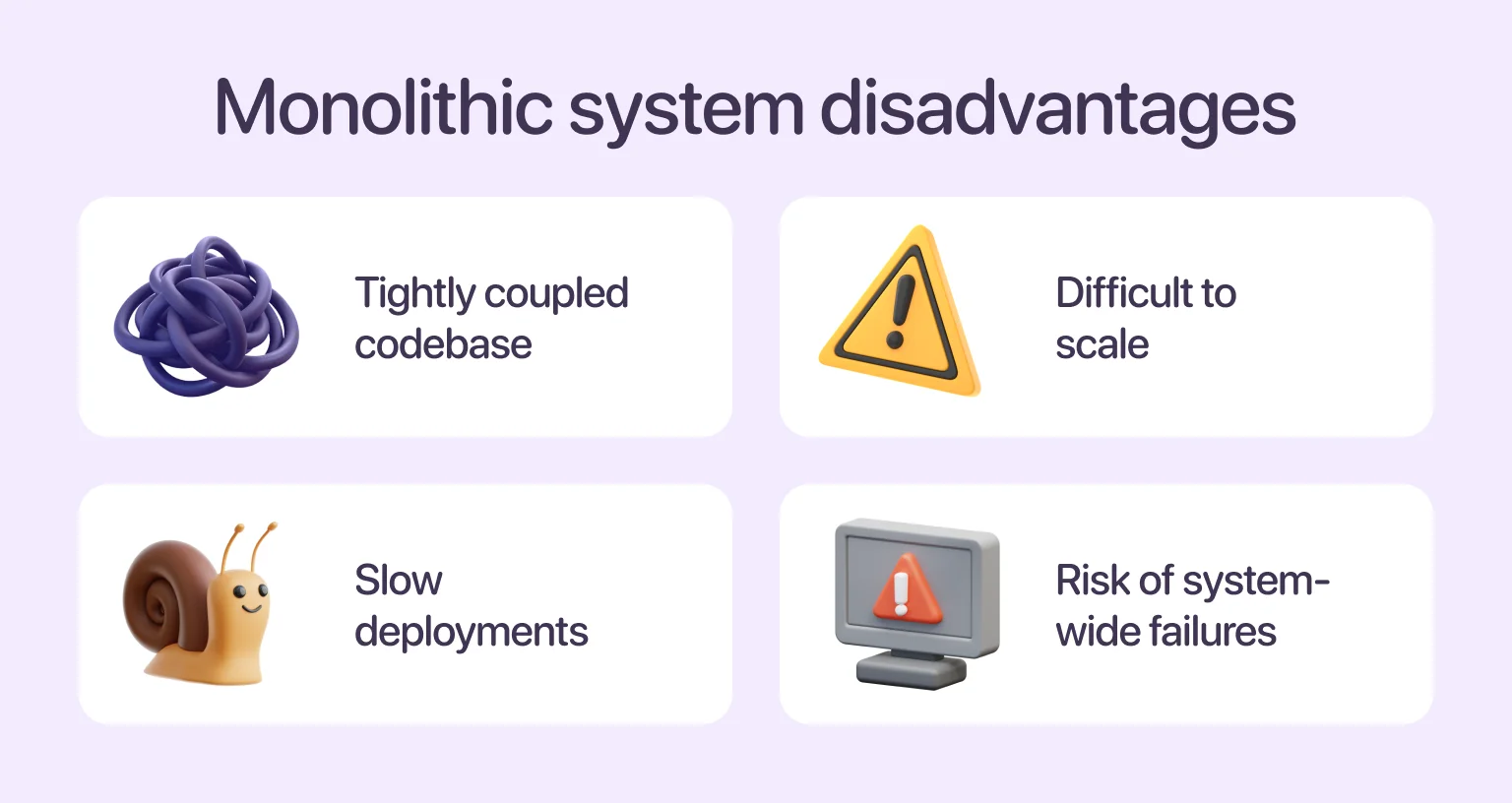
In the late 1990s and early 2000s, large companies experimented with Service-Oriented Architecture, which introduced the idea of splitting systems into services, but it was often too complex and heavy. A turning point came with the rise of companies like Amazon, Netflix, and Spotify. Their rapidly growing products made monolithic systems a bottleneck. At Amazon, the principle “You build it, you run it” was introduced, promoting small, autonomous teams fully responsible for their own services.
Microservices architecture takes this concept further by splitting an application into small, independent services, each responsible for a specific business function and capable of being developed, deployed, and scaled independently. Seen this way, the evolution of microservices is a story of balancing manageability and flexibility. Originally introduced to address the limitations of monolithic systems, microservices have since become a standalone architectural approach used for both new and existing products.
If you want to explore how this approach compares to traditional systems, our guide on monolithic vs. microservices architecture goes into more detail.
One of the main advantages of microservices is that they don’t become unwieldy, which makes them flexible and easy to maintain. However, before deciding whether they’re right for your project, let’s consider what else they can offer.
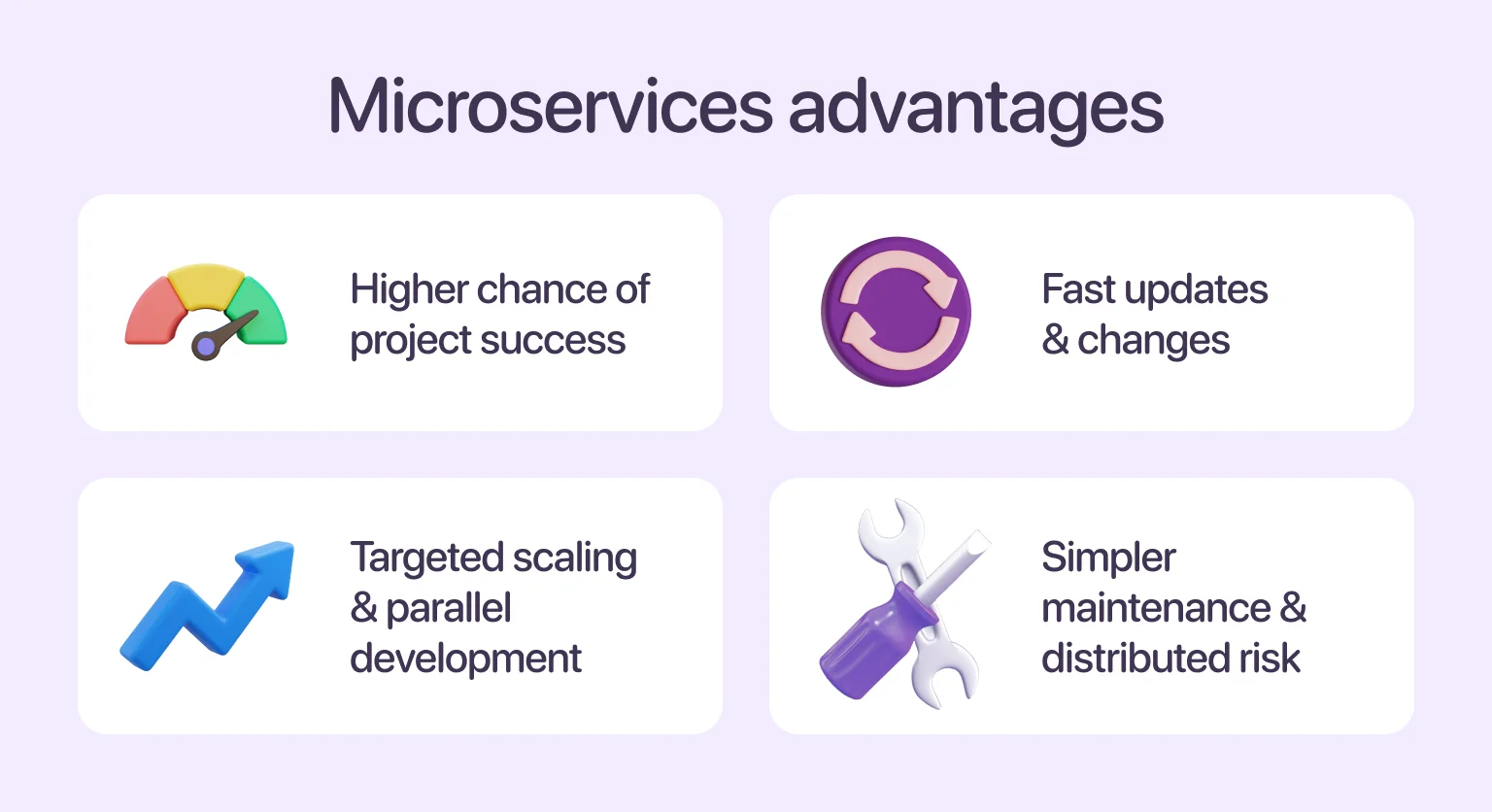
Statistics show a 51% success rate for small projects, compared with only 13% for large ones. Since microservices are small, the probability of completing each one is significantly higher. This is why most large projects today are planned with microservices from day one. Breaking a project into independent modules reduces overall complexity and fosters success.
Starting a new project is great: everything is fast, debugging is quick, and tests run instantly. But as the project grows, making changes takes longer. Eventually, the cost of making a change exceeds the projected economic benefit. Microservices can help you avoid this because each service is a small module here. Updates are fast and don’t crash the entire system.
With microservices in place, you can pinpoint high-priority areas that need extra resources and scale only that part of the system. Besides, different teams can work on separate parts of the system simultaneously without waiting for others to finish. This significantly speeds up the development process.
The larger the system, the harder it is for new developers to understand the code. It eventually becomes a “black box” operating on obscure laws known only to the most senior staff. Microservices are much simpler in this regard — each is a manageable, independent unit. With them, the risk is spread across the system. New developers can take over specific services without endangering the whole project.
These advantages become especially clear in practice when we look at companies scaling complex digital products. Take Spotify, which organizes its engineering teams into “squads,” each responsible for specific services like playlists or search. This setup allows teams to update features quickly and experiment safely. The list of such companies could go on, but will their architecture work for your business?
Microservices are a game-changer for large, high-load projects. However, for small projects, they can create a set of challenges.
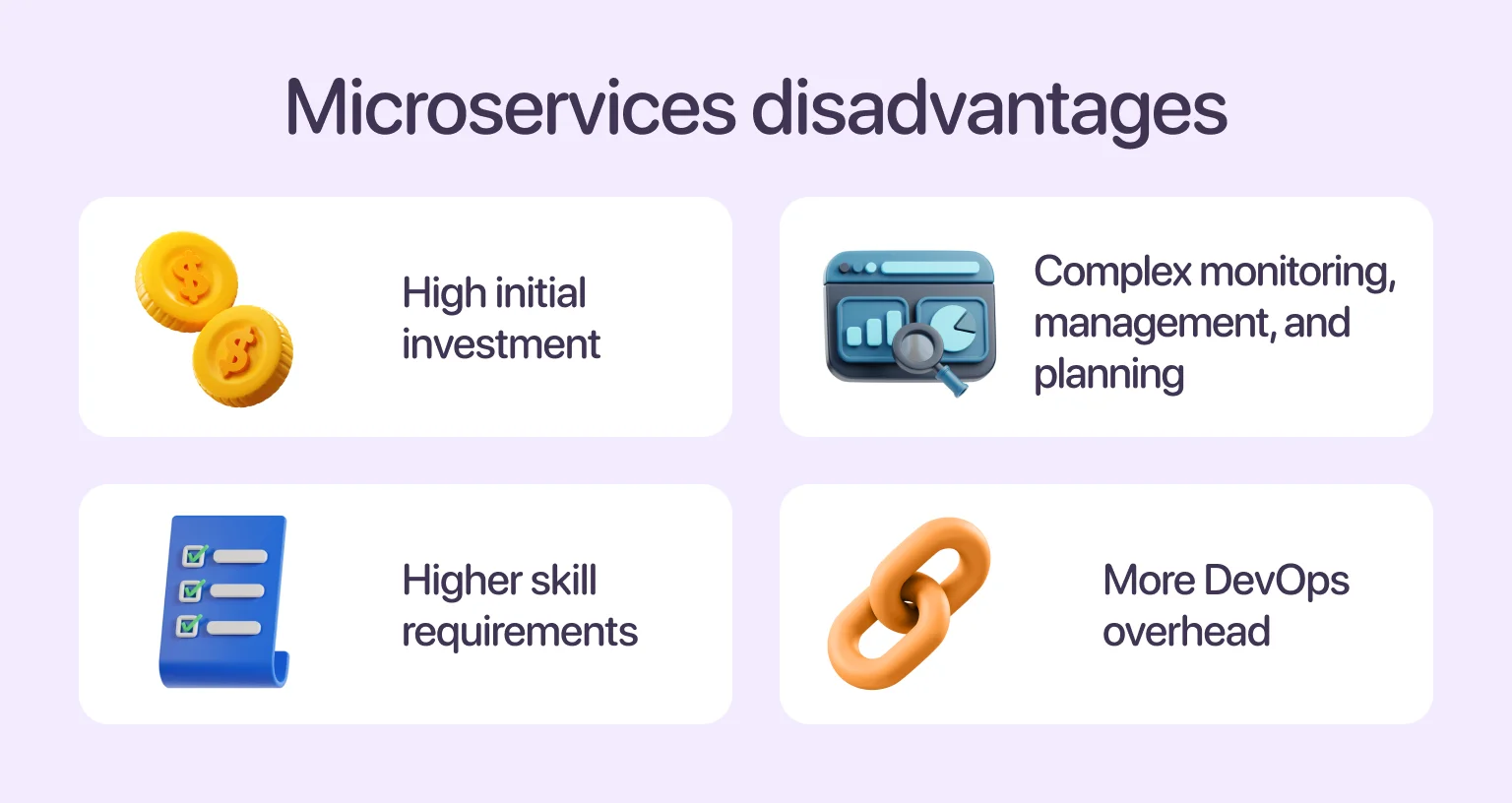
When people say that microservices require a higher initial investment, they are referring to the additional time, effort, and cost needed upfront to design and set up the infrastructure. This typically includes configuring multiple services, servers, databases, monitoring tools, and deployment pipelines, as well as reliable communication between services. For small or early-stage projects, this level of complexity is often overkill.
While traditional architecture is like building one house — understandable and straightforward, microservices architecture is like city planning. You can’t start building houses without a plan for roads, utilities, and grids. Besides, in microservices, components talk via API. This creates additional layers of complexity for debugging and monitoring the system.
Another drawback of microservices is the increased operational overhead. Maintaining a microservices-based system requires more DevOps effort, as teams must manage multiple services instead of a single, centralized application. As a result, microservices demand stronger operational maturity and additional resources to keep the system stable and efficient.
With many constantly changing parts, microservices add architectural complexity and increase the need for experienced developers. Teams must understand distributed systems, databases, inter-service communication, and failure handling. Solving these challenges requires not only technical skill but also a solid understanding of system architecture, making it harder and more expensive to find skilled specialists.
“Breaking things into pieces can speed growth, but it demands investment, expertise, and constant care.”
These challenges aren’t merely theoretical. SoundCloud, for instance, faced three of them: complex monitoring, planning, and DevOps overhead. The company was rapidly growing, and adopting microservices seemed like the right choice. It did help with scaling, but monitoring, debugging, and incident response became overwhelming as service complexity outpaced the team. SoundCloud later addressed it, reduced the number of services, and invested heavily in internal tooling. But wouldn’t it be easier to know exactly when a project should move to microservices? Keep reading to find out.
Although there is no universal rule for when to use microservices in a project, in the right situations, they can transform how a product grows, scales, and performs under pressure. The following factors highlight the conditions in which microservices offer genuine, practical benefits.
If your application is growing rapidly, with a constantly expanding codebase and updates taking longer to implement, microservices can help reduce overall complexity. By breaking the system into smaller, independent services, each part becomes easier to understand, maintain, and scale. Ideally, the size of each service should be manageable enough that a single developer (or a small team) can hold all its details in their head. This approach speeds up development and makes it easier to isolate issues, deploy updates, and adapt to changing requirements as the project grows.
When a big team works on a single project, developers inevitably start stepping on each other’s toes while making changes to a shared codebase. Microservices allow you to split responsibility, assigning each part of the team to its own separate service.
There are various methods of determining the optimal size of a microservice team. For small projects, the “one developer — one microservice” rule is often followed. Amazon, a giant in the industry, uses the “Two-Pizza Rule.” This states that a team should be small enough to be fed by two pizzas. If this is not the case, then the microservice has become too large and has taken on too much functionality. It should therefore be split into smaller pieces to return the team to a healthy, productive size.
Microservices let you launch large projects more quickly by working on individual components simultaneously. This helps you respond swiftly to market changes and stay ahead of competitors.
“Whenever every small update requires restarting the entire system, innovation slows down.”
Imagine launching a product that goes viral. As more users join, you want to act on their feedback and improve the product, but your initial architecture is a monolith. Every change means restarting the whole system, which slows development. If you don’t adapt, competitors could easily overtake you. That’s where microservices come in — they enable faster updates and give you the flexibility to experiment and respond to new trends.
When an application has a large user base, microservices simplify scaling the parts of the system under the most pressure rather than scaling everything at once.

Let’s use eBay as an example. Initially, they relied on monolithic architecture. However, as the platform expanded, peak loads, such as during sales, became a significant challenge. The monolith did not allow scaling individual parts of the site, and the service lost customers during sales due to crashes. After switching to microservices, it became possible to reinforce only those components under maximum load, keeping the rest of the marketplace stable even during the busiest auctions.
If a single problem causes a major outage and brings down the entire system, it’s a clear sign that the architecture has reached its limits and that switching to microservices might be necessary. In monolithic systems, increasing complexity means that one failure can take everything offline, leaving users completely disconnected. In contrast, microservices confine failures within individual components, allowing the rest of the system to keep running with minimal disruption.
After examining the advantages, disadvantages, and conditions for using microservices, it becomes clear that this architectural approach is not a one-size-fits-all solution. While it can significantly improve scalability, flexibility, and team independence, it also demands greater operational effort, technical skill, and upfront investment. The key question, then, is not whether microservices are “better,” but whether they fit the current stage of your product’s development. Ultimately, the best architecture is one that supports your business’s strategic goals today while leaving room for growth tomorrow.



.avif)