




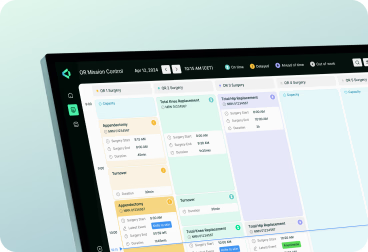



For years, outsourcing IT was simple arithmetic: the same work, done offshore, for less. That logic still holds, but it’s no longer where projects are won or lost. What tips them one way or the other now is something most companies still don’t think to check for.

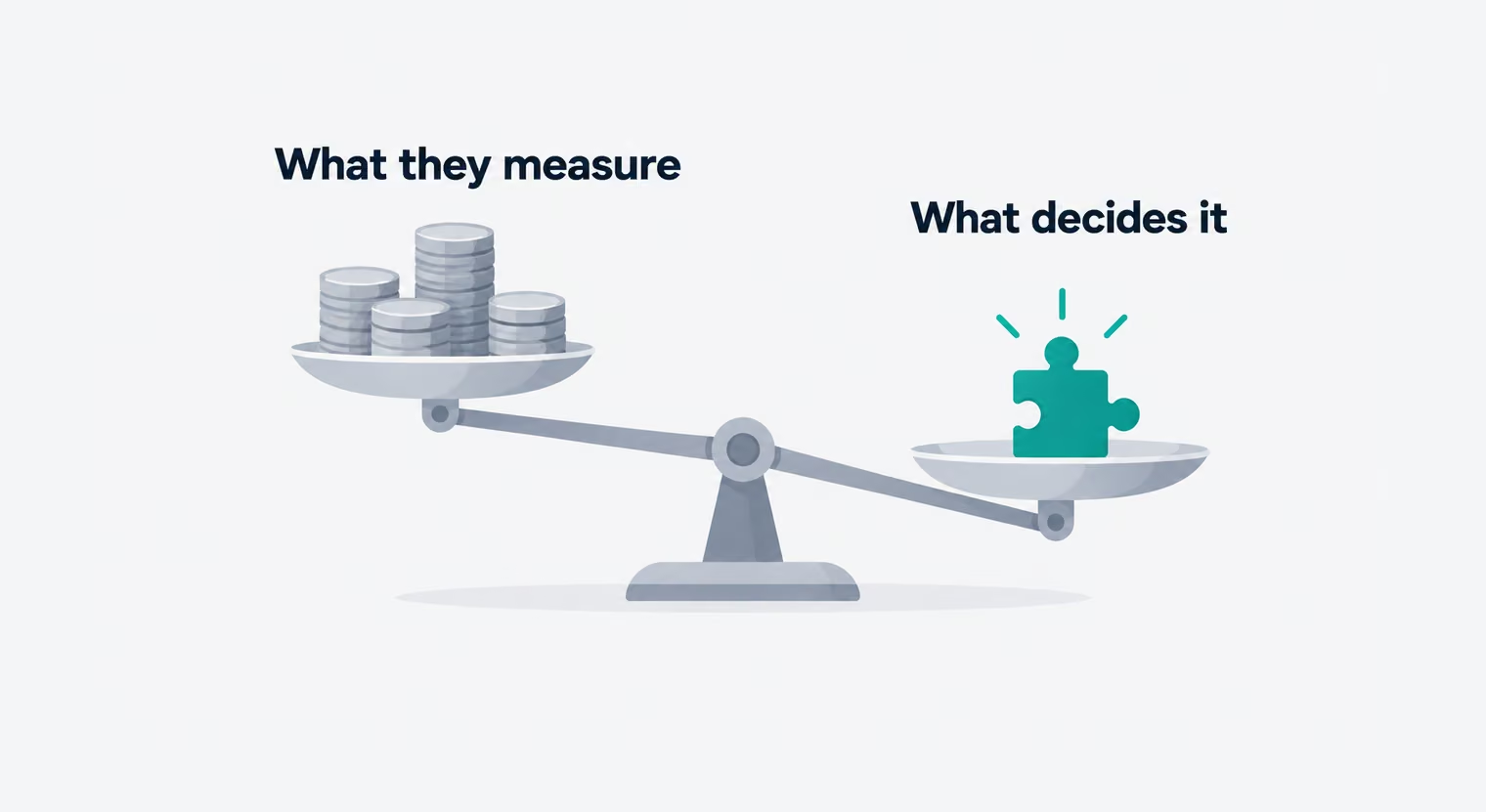
That something is the difference between capacity and capability. Capacity is headcount — developers added, hours billed, cost per seat. Capability is the specialized expertise and engineering maturity a hard system actually demands, which a headcount number says nothing about.
With the global IT outsourcing market projected to exceed $820 billion by 2031, the money is moving toward the second. This guide is a framework for making that investment work: choosing an engagement model, vetting for real engineering depth, protecting your IP, and running the partnership so it compounds rather than resets.
Many outsourcing failures trace back to a mismatch between the engagement approach and the shape of the project. A capable team on the wrong footing underdelivers as surely as a mediocre one on the right one.
The five common models trade control, flexibility, and management overhead differently, and which one fits depends on how stable your scope is and how much of the day-to-day you want to run yourself:
| Engagement model | Control level | Best for | Key trade-off |
|---|---|---|---|
| Staff augmentation | High | Filling specific skill gaps with strong internal leadership | You manage velocity; the external team follows your process |
| Dedicated teams | Medium-high | Ongoing product development, evolving roadmaps | Vendor builds domain memory, compounding delivery velocity |
| Project-based | Low | Well-defined, standalone projects with fixed requirements | Predictable cost but inflexible when requirements change |
| IT outstaffing | High | Long-term, full-time virtual satellite office | Engineers embed into your team; the vendor handles employment and admin overhead. |
| Managed team | Medium | Clear vision, limited internal management bandwidth | Vendor owns day-to-day ops; you define outcomes |
Two axes settle most of the decision: how much your roadmap will change, and how firm your scope already is. A shifting roadmap favors a dedicated team or outstaffing model, since both build domain memory that compounds over time.
A fixed, well-defined scope points to a project-based engagement instead, where the right software development model can make delivery more predictable. And when neither is clear-cut, staff augmentation can be a lower-risk way in — a chance to judge a vendor’s engineering culture on real work before committing to anything deeper.
{{banner}}
The people who sell an engagement aren’t always the ones who deliver it, so a polished pitch tells you little about the engineers who will actually write your code. What you’re really assessing is maturity — technical depth, operational discipline, and the habits of a team under pressure — and none of it, as a rule, shows up in a capabilities deck. It has to be drawn out deliberately, across three areas.
Claims of seniority and past projects are easy to make and hard to verify from the outside. The way past that is to watch the work happen:
Where technical vetting tests individuals, operational health looks at how the team works as a unit — the habits that determine whether good engineers produce reliable software or just working demos. A few direct questions surface it:
The most valuable engineering partner is one willing to tell you that you’re wrong. A vendor who agrees with every decision, praises every plan, and raises no objections isn’t easy to work with — they’re withholding the judgment you’re paying for.
Productive friction is the opposite: a team that surfaces risks early, questions assumptions, and pushes back on a bad idea before it becomes expensive code. That instinct is hard to fake in a vetting conversation, so it’s worth probing directly — describe a flawed technical plan and see whether they challenge it or nod along.
“A strong engineering partner challenges bad decisions before they become expensive code.”
Outsourcing puts your source code, data, and business logic onto someone else’s infrastructure. Protections that may have stayed implicit in-house often need to be spelled out contractually before sensitive assets or data change hands. The regulatory bar is climbing, too — CCPA, the EU AI Act, and data-sovereignty rules can add new obligations depending on the data, systems, and jurisdictions involved. The pieces that build that protection follow below.
Legal protection in outsourcing is sequential, and each agreement has to be in place before the moment it is meant to cover:
Of the three above-mentioned documents, the MSA carries the most weight, which is why it needs the closest reading. The NDA and DPA each do one focused job, but the master agreement governs the entire relationship, so its gaps cost the most later. At a minimum, it should pin down:
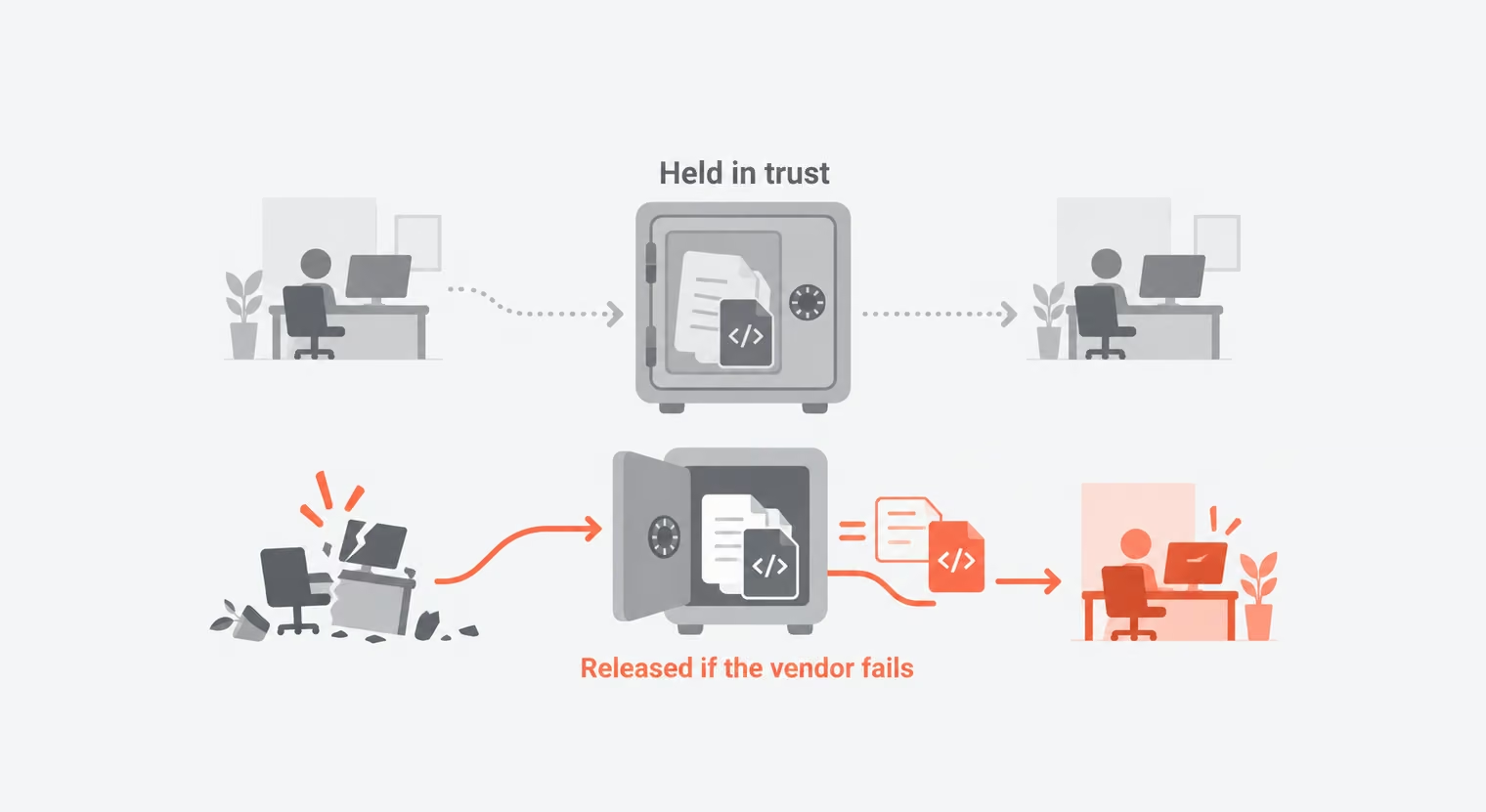
Escrow is a safeguard borrowed from finance: a neutral third party holds something valuable in trust and releases it only when specific, agreed conditions are met. Applied to software, it answers one question — what happens to your code if the vendor disappears.
The agent holds the deposit materials — source code, build scripts, infrastructure-as-code, and documentation — and releases them if a contractually defined trigger occurs, such as vendor insolvency, failure to maintain the software, or another agreed continuity event.
Vetting and contracts bring the right team in. Whether they perform comes down to daily execution, and the aim is to make sure their external status doesn’t create distance from the work. Getting there rests on what follows.
The distance that hurts a distributed team is rarely geographic — it’s often the small daily frictions of working apart, and the measures below are aimed squarely at closing them:
Most of the numbers a vendor will happily report — hours logged, story points, lines of code — measure activity, and activity is easy to inflate without producing anything of value. The metrics worth tracking measure outcomes instead, and these columns rarely point the same way:
| Metric | Why it matters | What to avoid |
|---|---|---|
| Cycle time | Measures delivery velocity end-to-end | Measuring only billable hours |
| Deployment frequency | Indicates CI/CD maturity and team confidence | Story points as a velocity proxy |
| Defect escape rate | Tracks quality gate effectiveness | Lines of code written |
| Mean Time to Recovery (MTTR) | Evaluates incident response capability | Attendance and hours logged |
An undocumented decision usually has to be rediscovered when someone new touches the code. A documented one is made once and reused indefinitely. That difference is what compounds across a long engagement.
With each choice and its reasoning written down, the external team’s output accumulates into an asset your own engineers can build on, rather than a black box that has to be reverse-engineered the moment the original author moves on. The discipline costs real time at the moment. It pays that back every time a decision doesn’t have to be made twice.
“A documented decision is one your team won’t have to figure out again later.”
AI coding tools are now widely used across software teams, which means your outsourcing partner is likely using them somewhere in the delivery process. That changes what you’re buying, and it puts a new question on the vetting list: does the partner apply AI in a way that makes your software better, or quietly worse? The question becomes even more important with agentic AI architecture. Let’s look at how to tell.
Modern outsourcing partners should leverage AI coding assistants to:
AI-generated code brings its own failure modes, and they’re easy to wave through in a quick review if you’re not specifically looking for them. That’s why AI in the mix calls for more scrutiny rather than less. Three patterns are worth watching for.
A model reproduces the patterns it learned from, including the vulnerable ones. Known weaknesses get embedded in code that looks unremarkable on the page, having been absorbed from the flawed examples the model was trained on.
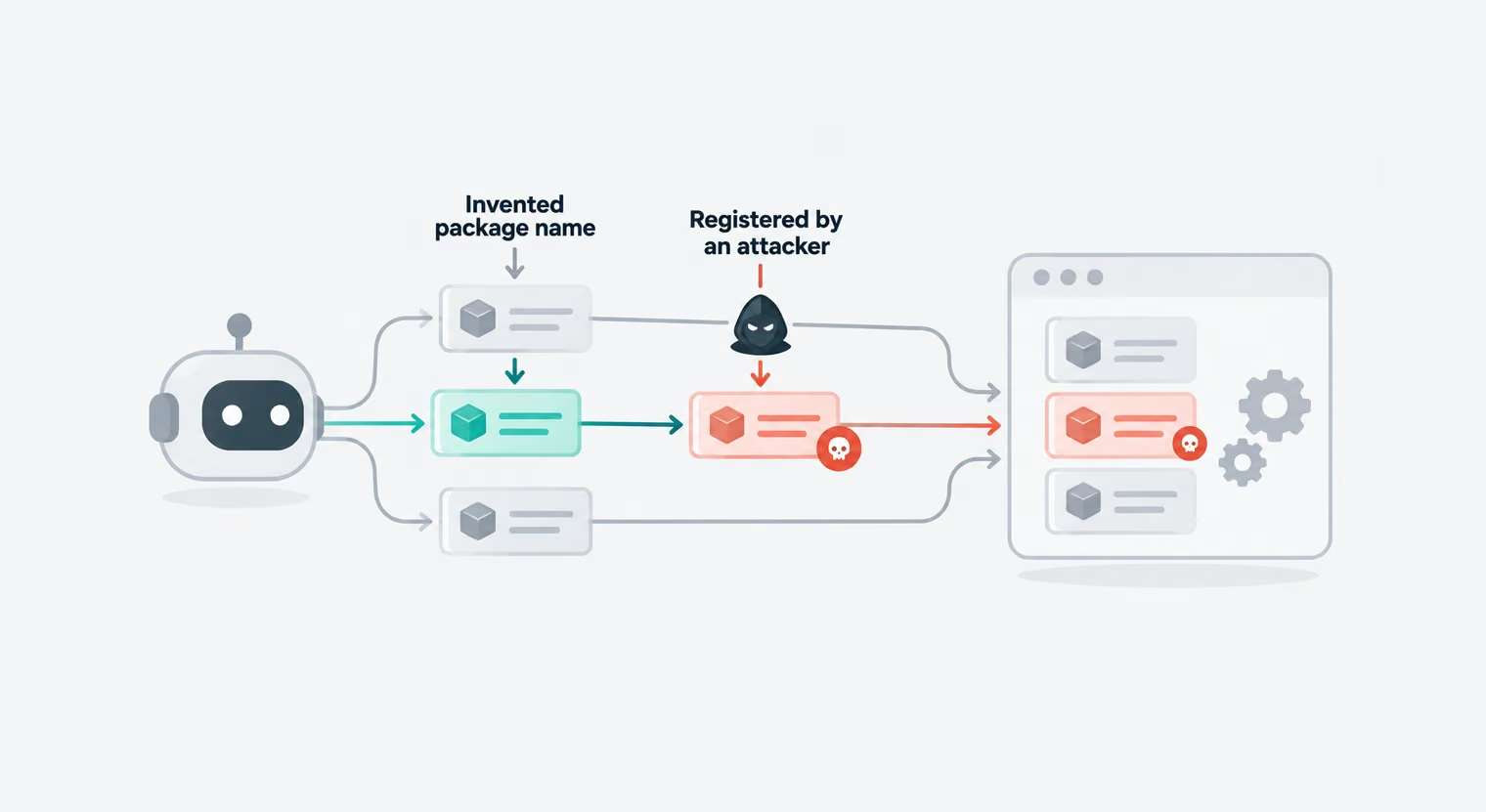
Models sometimes import packages that don’t exist. The greater danger is that attackers may register those invented names as real, malicious packages. If that happens, a hallucinated dependency can become a software supply-chain risk.
The most deceptive pattern can pass every unit test and still break under real load. A unit test proves the code works on a small, controlled input, but AI-generated code may handle the tested case while missing what happens at high volume or under concurrent requests.
Maturity with AI comes down, first of all, to discipline: whether a partner catches what it gets wrong. It shows up as specific, checkable practices:
Strong outsourcing partnerships tend to have the same foundation: the right engagement model, proven engineering maturity, clear ownership, and a working setup that keeps the external team close to the product.
That means matching the engagement to the roadmap, checking engineering maturity before delivery starts, defining ownership and security early, and bringing the external team into the same tools, documentation, and decision-making processes as everyone else.
When those pieces line up, outsourcing becomes easier to build on over time. You gain access to expertise that may be hard to hire internally, knowledge stays with the product instead of disappearing with individual contributors, and the partnership gets stronger as the team learns the system and the business around it.
{{banner-2}}


.avif)