







Serverless changed the deal web teams make with their infrastructure. Instead of provisioning and running servers, you deploy functions that scale and execute on demand, and the provider handles what sits beneath. It sounds like pure upside — which is exactly why so many teams adopt it before discovering where it charges them back.

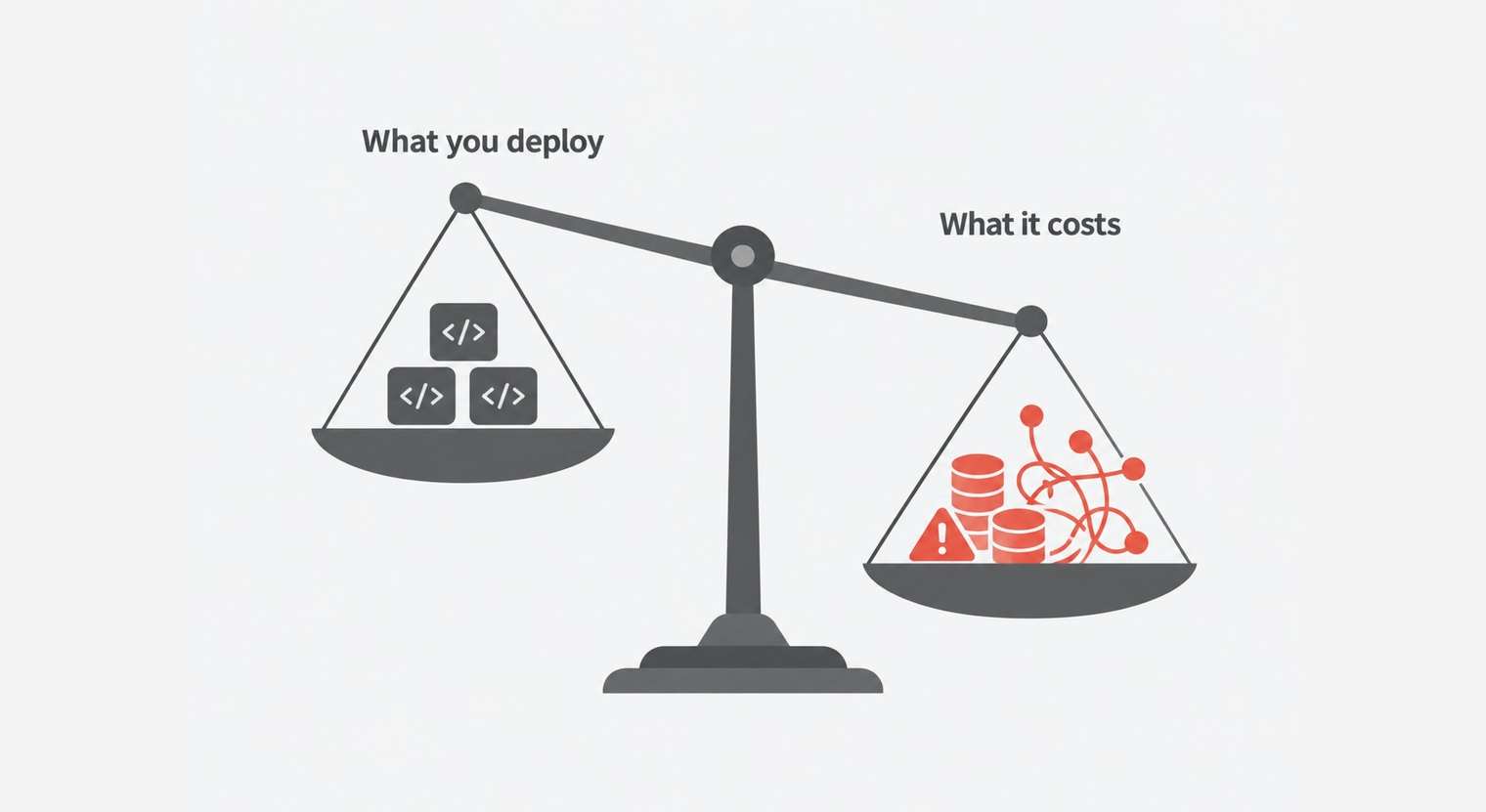
They’re adopting it anyway, in growing numbers. Global Market Insights valued the serverless architecture market at around $18 billion in 2025, while forecasts for 2035 range from about $35 billion to nearly $158 billion — a wide spread in estimates, but a consistent expectation of continued growth. What the enthusiasm skips is the cost side: cold starts, execution limits, runaway bills, and debugging that worsens as the system spreads.
The reassuring part is that these difficulties aren’t yours to face alone. For instance, AWS, Azure, Google, and Cloudflare all pour real resources into narrowing them, so the gap between what serverless promises and what it costs to run keeps shrinking.
This guide maps that landscape: where serverless pays off, where it quietly costs more than what it replaced, and how to tell which case you’re in before you commit.
Serverless is attractive for a mix of reasons — what it saves you in cost and effort, and what it makes easy that used to be hard. The following benefits account for most of that appeal.
Rather than charging for a continuously running instance, serverless typically meters execution time and request volume, so you’re not paying for the same amount of idle capacity as with always-on infrastructure. What that means concretely varies across the four platforms this guide follows:
Where the workload fits, the savings are real. Enterprises moving appropriate workloads to serverless can cut infrastructure costs. In AWS case studies, FINRA reports using Lambda to analyze up to 75 billion market events a day, while an earlier AWS account of its serverless adoption reported cost reductions of more than 50%.
The same model, though, makes spending harder to predict, and under the wrong conditions, serverless runs are more expensive than the infrastructure it replaced. The usual culprits:
Most of these are containable with a few guardrails: reserved-concurrency limits to cap runaway scaling, Dead Letter Queues to catch failed events, cost alarms wired to automatic alerts, and circuit breakers on external dependencies.
One cost hides in plain sight, because it isn’t the function at all. In many architectures, the function is cheap, and the services behind it aren’t — databases, APIs, and AI inference all scale with invocation volume, so downstream costs can easily outweigh the function bill itself.
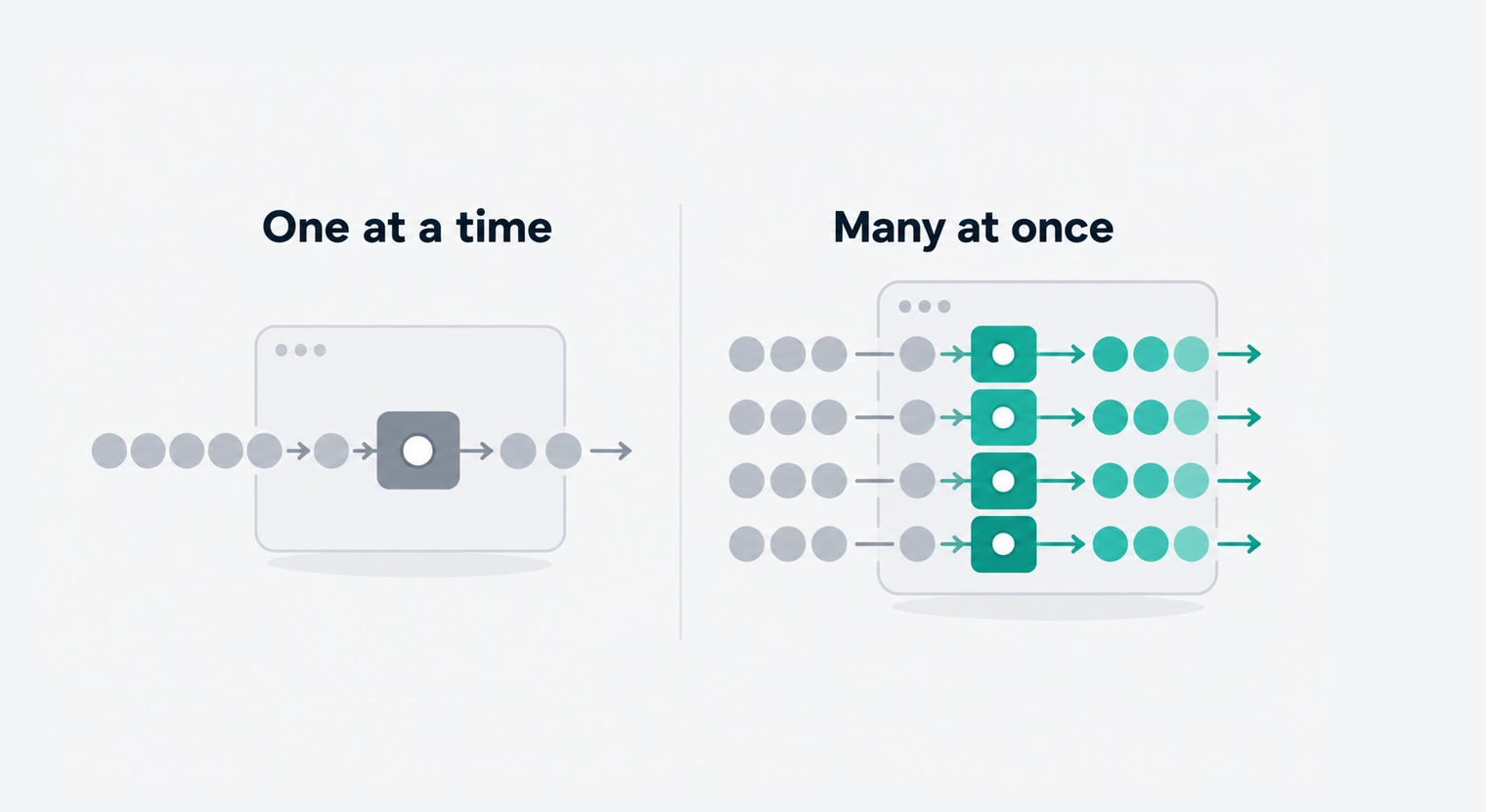
Serverless platforms scale from zero to thousands of concurrent executions on their own, with no manual intervention — though that scaling isn’t unbounded. Account-level concurrency limits and regional burst quotas both apply, and a sudden traffic spike can hit them and trigger throttling. How much headroom you have before that happens differs across the platforms:
Serverless functions connect directly to event sources, which is what makes them a natural fit for event-driven web applications — a function runs in response to something happening, rather than sitting idle waiting to be called. Those triggers fall into a few categories:
Much of the day-to-day work of running infrastructure disappears here, handed to the provider — but it’s replaced by a subtler cost in observability and monitoring. What the provider takes on:
In return, the harder problems become yours:
The upside sits underneath all of it: the provider builds in fault tolerance, automatic failover, and distributed execution, reducing some of the infrastructure-level reliability work the team would otherwise handle itself.
{{banner}}
Serverless suits some workloads and actively works against others, and the difference rarely announces itself upfront. Let’s look at the constraints that draw that line.
A cold start happens when an execution environment must be built from scratch, adding latency to the first request after an idle period. How much depends on the runtime:
| Platform | Runtime | Cold start time |
|---|---|---|
| AWS Lambda | Python 3.12 | 100-200ms |
| AWS Lambda | Java 21 | 1-3 seconds |
| AWS Lambda | .NET 10 AOT (ARM64) | <50ms |
| Google Cloud Run functions | 2nd gen | <1 second |
| Cloudflare Workers | V8 isolates | ~5ms (near-zero) |
These are typical ranges — package size and networking configuration, VPC integration especially, can stretch actual times from milliseconds to several seconds. Cold starts matter more than the raw figures suggest because of where they land: on tail latency — the p95 and p99 requests that shape user experience more than the average does — which makes them a real problem for user-facing APIs.
The cost sharpened in August 2025, when AWS began billing the INIT phase on managed runtimes. Initialization used to be free, and now it’s charged as execution time. The impact varies by runtime — lighter ones like Python and Node.js see little change, while Java and C#, with longer initialization, feel it most: for heavy runtimes, cold-start costs can rise from roughly $0.80 to $17.80 per million invocations.
The latency is manageable with the right tool for the workload:
Functions run under hard timeouts, which rules them out for genuinely long-running work. The ceiling varies by platform:
| Platform | Maximum execution time |
|---|---|
| AWS Lambda | 15 minutes |
| Azure Functions Flex Consumption | 30 minutes by default; maximum unbounded |
| Google Cloud Run functions 2nd gen | up to 60 minutes, depending on trigger type |
| Cloudflare Workers | CPU time varies by plan and workload |
Cloudflare is an exception worth understanding. Where the others cap wall-clock time, Cloudflare Workers cap CPU time — 10 ms per request on the Free plan, up to 5 minutes on Paid — so a Worker can run much longer in elapsed time while waiting on I/O, like a network request or a stream, since only active processing counts against the limit.
For workflows that genuinely need to outlast these ceilings, AWS closed much of the gap in December 2025 with durable execution for Lambda. Inspired by Azure Durable Functions, it lets a function checkpoint its progress automatically, suspend for up to a year, wait for external events without paying for compute, and resume from its last checkpoint after a failure.
The capability comes with a hard constraint. Because a durable workflow replays its execution to resume, the logic has to be deterministic — which rules out three things inside it:
Runtime support has expanded since launch, with managed support now covering Node.js, Python, Java, and .NET. Each individual step still remains subject to Lambda’s standard execution limits.
Durable execution brings code-first orchestration to Lambda, alongside AWS Step Functions. The feature also narrows the distance to Azure Durable Functions, though Azure’s version remains more mature, with better local debugging and broader language support.
Beyond time, functions run under caps on memory and payload size that vary widely by platform. Memory matters most for compute-heavy work like image processing or data transforms, while the payload ceiling quietly shapes your architecture — a limit smaller than your data forces you to stream through object storage rather than pass it directly. The table below sets the limits side by side:
| Platform | Memory | Payload size |
|---|---|---|
| AWS Lambda | 128 MB – 10 GB | 1 MB async, 6 MB sync |
| Azure Functions Flex | 512 MB, 2 GB, 4 GB | up to 210 MB |
| Google Cloud Run functions | up to 32 GiB | 32 MB HTTP; event limits vary by trigger |
| Cloudflare Workers | 128 MB | 100 MB on Free/Pro, 200 MB on Business, up to 5 GB on Enterprise |
Each platform runs its own proprietary APIs and execution model, so code written for AWS Lambda won’t move to Azure Functions without significant rework. That coupling is the cost of the deep platform integration serverless depends on, and a few techniques keep it manageable:
A distributed architecture is where serverless is hardest to see into, and in production that opacity is one of its sharpest pain points. The trouble comes from a few directions at once:
The tooling has matured to meet most of this, turning problems that once meant guesswork into ones with a standard fix:
Functions are stateless by design, so a multi-step workflow has to coordinate its state externally — an architectural burden traditional stateful applications don’t carry. The complication runs deeper than storage, because serverless platforms generally guarantee at-least-once delivery, which means exactly-once processing is something you build. That shapes four distinct problems:
The fixes pair directly with those problems. Idempotency keys — unique request IDs written through DynamoDB conditional writes — stop duplicate events from being processed twice.
DynamoDB transactions give atomic multi-item updates where consistency matters, and short-lived Redis locks with a TTL coordinate state across functions without holding it. For genuinely complex workflows, managed orchestration through Step Functions or Lambda’s durable execution takes the coordination off your code entirely.
“When the platform guarantees at-least-once delivery, exactly-once becomes your problem to build.”
Securing serverless calls requires a different approach than traditional infrastructure — a wider attack surface and permission management that grows granular fast. The recurring risks are concrete:
| Risk | Where it bites |
|---|---|
| Over-permissioned roles | Wildcard permissions granted where a single specific action would do, multiplied across hundreds of settings. |
| Untrusted event input | Any source (S3, API Gateway, SQS) can carry injected or poisoned payloads, internal ones included. |
| Exposed secrets | Environment variables are not a dedicated secrets-management mechanism and can expose sensitive values to application code or users with configuration access. |
| Multiple entry points | Every trigger is a separate attack vector to secure. |
Serverless has no single perimeter to defend, so its security lives at each function and entry point instead of one network edge. That shifts the work toward a defined set of measures:
The past two years have pushed serverless into genuinely new territory. What follows are some of the more interesting examples, each expanding what serverless can realistically take on.
Serverless has moved toward heavier, more specialized work lately — running large models, processing media, streaming AI output. Five capabilities are worth a closer look.
Announced at re:Invent 2025, Lambda Managed Instances let functions run on EC2 instances from your own account, with specialized hardware configurations available. That opens access to the latest CPUs like Graviton4, custom memory-to-CPU ratios, and performance-optimized instances for ML inference, image and video processing, and document analysis.
Rust support followed in March 2026, enabling parallel request processing within a single execution environment through async Tokio runtimes. This enables parallel request processing within a single execution environment, helping improve utilization and throughput for suitable workloads.
In April 2026, Cloudflare Workers AI added Kimi K2.6 — a frontier-scale model with a 262k context window, multi-turn tool calling, and vision inputs — as one of its flagship models across text generation, image generation, speech, and embeddings.
GA across all commercial regions as of April 2026, Response Streaming supports streamed responses up to 200 MB for incremental payload delivery — LLM inference, real-time data processing, and large file generation. It matters most for AI applications, where the typewriter-effect experience depends on responses arriving incrementally.
Lambda functions gained the ability to read their Availability Zone through the metadata endpoint in March 2026, enabling routing decisions that keep traffic within a zone to reduce cross-AZ latency and data-transfer costs.
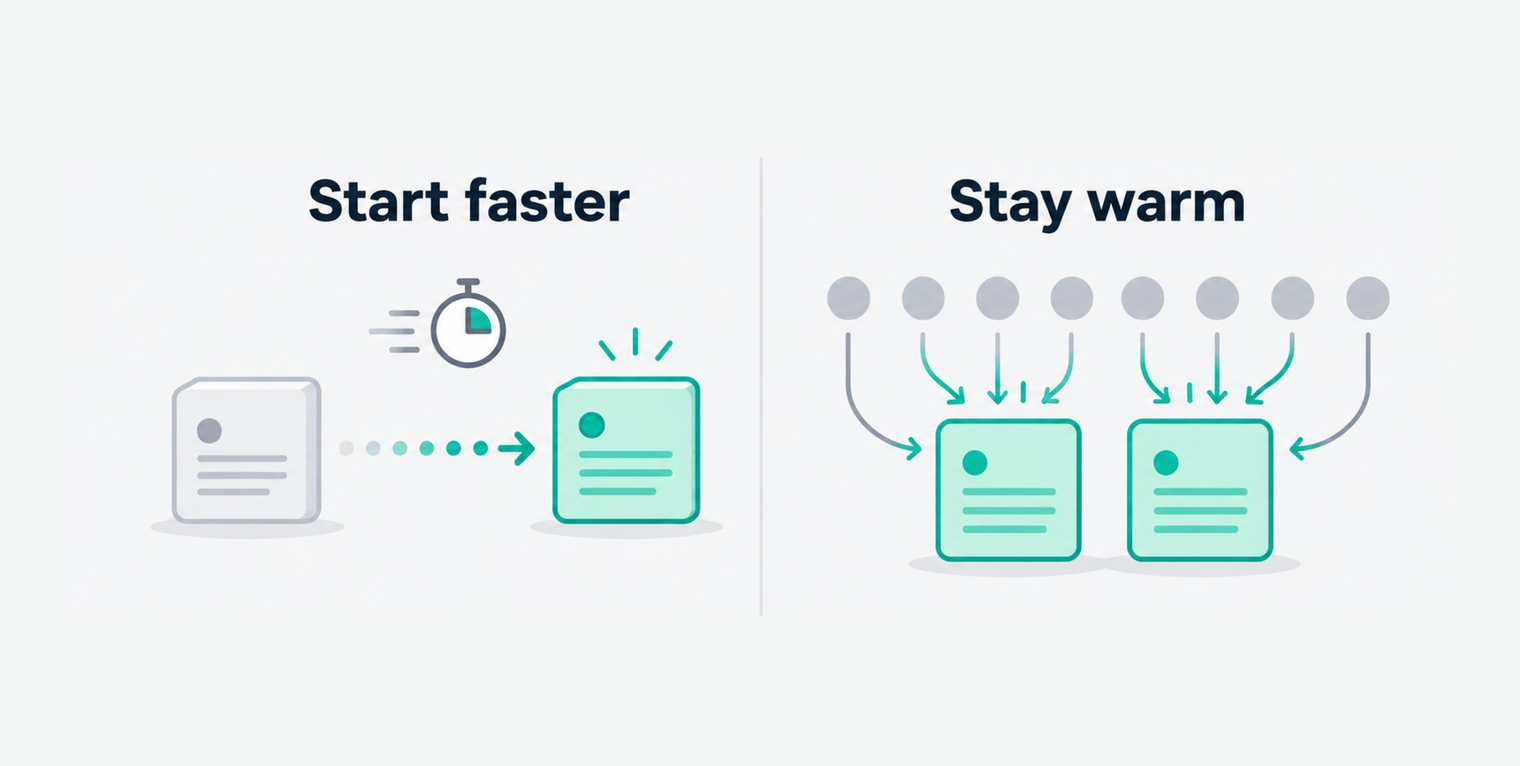
AWS Lambda .NET 10 Native AOT on ARM64 achieves sub-50ms cold starts. Google Cloud Run functions 2nd gen supports high per-instance concurrency, which can reduce the need to spin up additional instances under load. Azure Flex Consumption Always Ready keeps configurable baseline instances warm.
Node.js 20 reached its Lambda deprecation date on April 30, 2026. AWS currently lists February 1, 2027, as the date when creation of new functions using this runtime will be blocked, with updates blocked from March 3, 2027.
Amazon Linux 2 reached end of life on June 30, 2026, but Lambda runtimes based on AL2 continue to receive critical and selected important security patches until their individual deprecation dates. Teams should plan migrations to Amazon Linux 2023-based runtimes according to the lifecycle of the specific runtime they use.
Each platform carries its own balance of strengths and constraints, and seeing them side by side is what makes the fit clear:
| Platform | Natural fit | Key strength | Main caveat |
|---|---|---|---|
| AWS Lambda | AWS-centric, event-driven systems. | The deepest ecosystem and integration, now with durable workflows and specialized hardware. | Cold-start cost on heavier runtimes, and initialization is now billed. |
| Azure Functions | Microsoft-centric enterprises, approval workflows. | Mature stateful orchestration and tight Microsoft integration. | Best fit when the surrounding architecture is already Azure-centric. |
| Google Cloud Run functions | Data-heavy and AI-driven apps, mobile backends. | High per-instance concurrency and a strong native AI/ML stack. | Less of an edge presence than Cloudflare. |
| Cloudflare Workers | Latency-critical, global, edge-AI apps. | Near-instant cold starts at the edge, with frontier models available there. | CPU-time limits still shape what workloads fit best. |
The pattern underneath the table is that each platform is strongest where its parent’s wider strengths already lie — Lambda in AWS-native architectures, Functions in Microsoft shops, Google where data and AI dominate, Cloudflare at the edge. The platform choice, in most cases, follows the stack you’re already building on.
Serverless stops being the right tool in a handful of cases — some economic, some technical — and most come down to the shape of the workload. The trade-offs already covered account for most of them.
One failure mode sits outside those and tends to catch teams off guard: chatty inter-service communication. Each call between functions adds network latency, so a chain of several calls stacks up delay before any real work runs. Architectures with dense service-to-service dependencies may be better suited to container platforms with a service mesh.
The decision itself comes down to a few clear signals:
Serverless is often framed as a way to spend less and scale more, but its stronger effect is to move engineering effort off infrastructure and onto the product. The hours a team would pour into capacity, patching, and uptime go instead to features. That shift, more than any cost saving, is what draws teams in.
The catch is that the effort moves rather than disappears. It resurfaces as watching bills that swing with traffic, wiring observability across scattered functions, and designing for statelessness. Teams that plan for this second set of demands are better positioned to make serverless work well.
{{banner-2}}


.avif)

.avif)